Account Abstraction: Making Crypto Usable for Normal Humans
DAte
Category
Blockchain
Reading Time
7 Min
The current state of crypto wallets is absurd when you step back and look at it objectively.
You need ETH to send USDC. You need to approve every single transaction manually, even in apps you use constantly. Lose a piece of paper with 24 random words? Your money is gone forever, with zero recourse. Click one malicious link and a contract can drain your entire wallet. Want to use a new app? Better understand gas limits, slippage, and transaction ordering—or prepare to lose money to failed transactions.
This isn't a user experience anyone outside crypto would tolerate. Banks don't require you to memorize unrecoverable passwords. Payment apps don't make you approve every purchase twice. Normal software has "forgot password" buttons and spending limits and fraud protection.
Crypto has none of this because wallets are fundamentally dumb. They can't run code. They can't make decisions. They just sign things when you tell them to. All the intelligence lives in smart contracts, but your wallet? It's a glorified signature machine.
Account abstraction changes this. It makes wallets programmable. Suddenly, your wallet becomes as smart as the contracts it interacts with, and everything that's currently impossible becomes trivial.
Let's talk about what actually changes.
The Fundamental Problem: Wallets Are Dumb
Here's the thing nobody tells you about crypto wallets: they're not actually wallets. They're key managers. Tiny programs that hold private keys and sign transactions. They can't do anything smart.
Want to pay someone? You sign. Want to approve a contract? You sign. Want to recover your account? You can't—unless you have those magic words written down somewhere.
Wallets can't:
Pay their own gas fees
Recover from lost keys
Require multiple signatures
Have spending limits
Schedule transactions
Cancel pending transactions
Use biometric authentication natively
Learn from your behavior
Protect you from obvious scams
They're incredibly dumb for something that controls all your money.
Why? Because Ethereum (and most blockchains) was designed with two types of accounts: Externally Owned Accounts (EOAs) that humans control with private keys, and Smart Contracts that run code. Your wallet is an EOA. EOAs can't run code. They just sign things.
All the intelligence in crypto lives in smart contracts. Your wallet? It's just a signature machine.
Account abstraction flips this. It makes your wallet a smart contract. Suddenly, your wallet can run code. It can make decisions. It can be as sophisticated as any DeFi protocol.
What Account Abstraction Actually Does
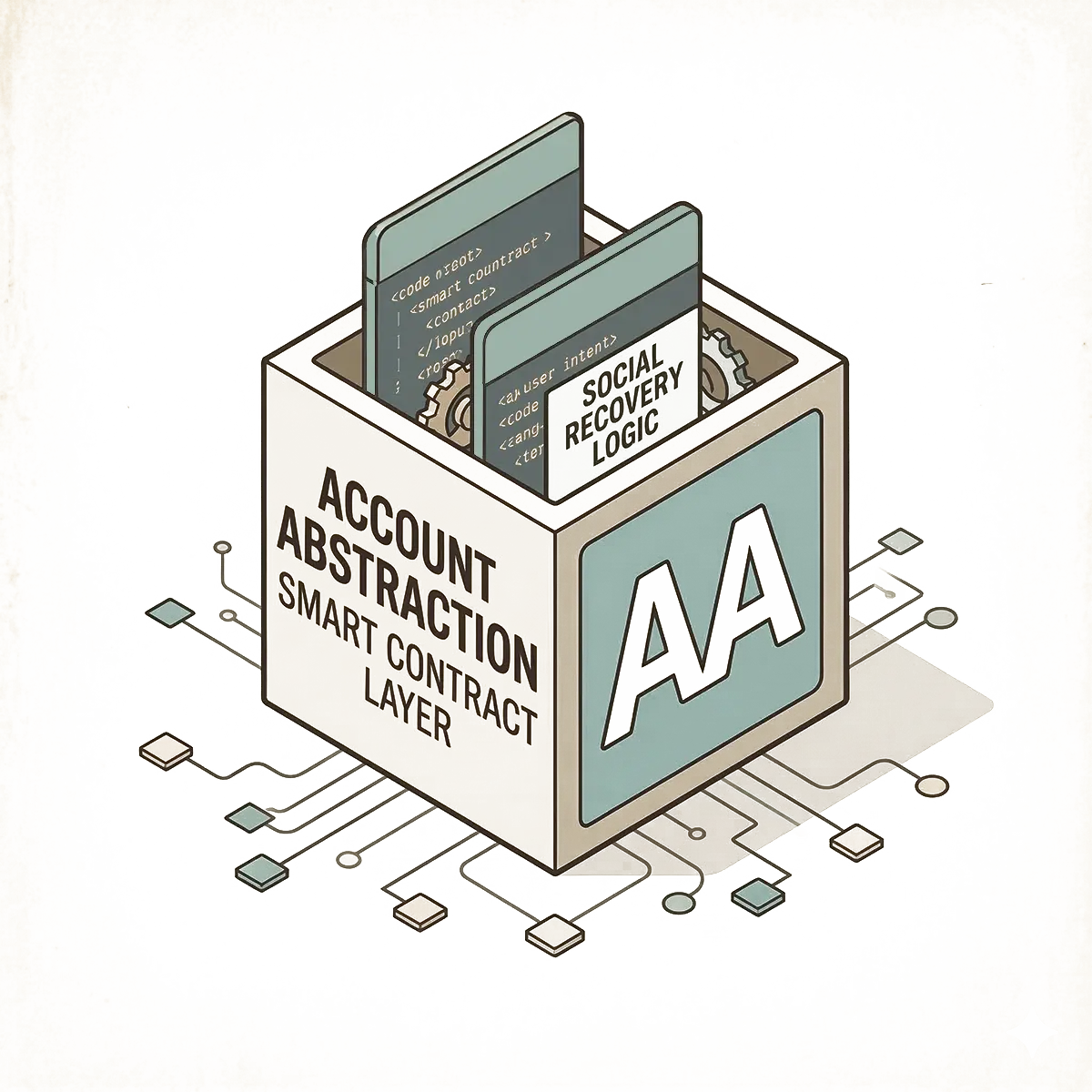
Account abstraction (specifically ERC-4337) makes your wallet programmable. Instead of "I sign, therefore it happens," you get "I sign, and my wallet's code decides what happens next."
This unlocks capabilities that sound simple but are revolutionary:
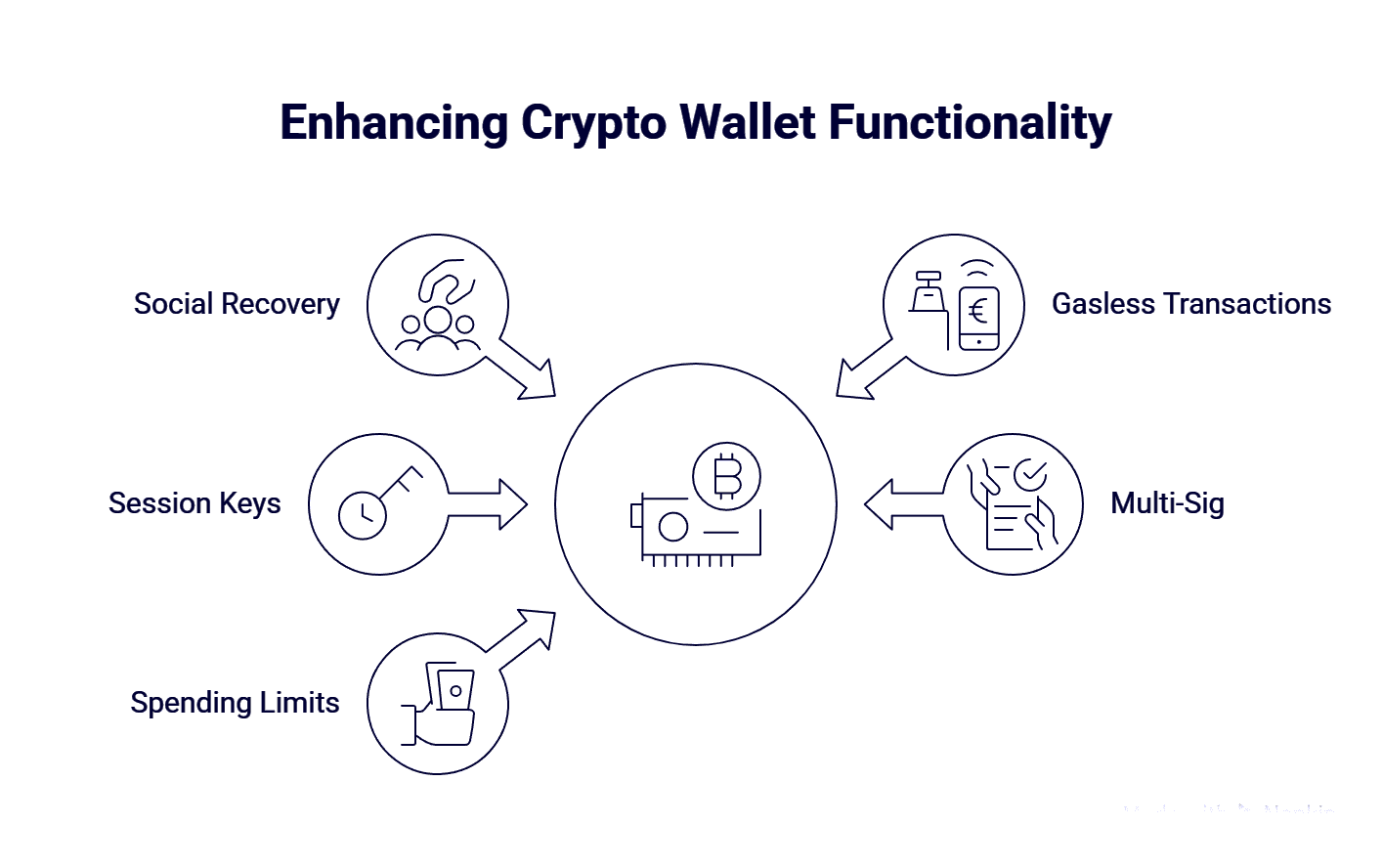
Social Recovery: Never Lose Your Money Again
Traditional wallets: Lose your seed phrase, lose everything. Forever. No exceptions.
With account abstraction: Your wallet can have recovery mechanisms built in. Designate trusted contacts—if you lose access, a threshold of them can help you recover. Or use email verification. Or hardware wallet backup. Or time-locked recovery where you can reclaim access after a waiting period if nobody objects.
The result: Account recovery works like every other service people use, not like a nuclear launch code you can never replace.
Gasless Transactions: No ETH Required
Traditional wallets: You need ETH to do anything on Ethereum. Even if you're just sending USDC to someone, you need ETH for gas. Want to trade on Uniswap? Need ETH. Want to vote in a DAO? Need ETH.
With account abstraction: The application can pay gas for you. Or you can pay gas in the token you're already using. Sending USDC? Pay gas in USDC. Buying an NFT with MATIC? Pay gas in MATIC.
Users never need to know what "gas" is. The app handles it.
Session Keys: Use Apps Without Signing Everything
Traditional wallets: Every single action requires manual approval. Play a blockchain game? Approve every move. Trade on a DEX? Approve every swap. Use a dApp for 10 minutes? Sign 47 transactions.
With account abstraction: Grant temporary permissions. "This game can spend up to 10 USDC for the next hour." Now play without interruption. The session key handles it. After an hour, it expires automatically.
It's like staying logged into a website instead of entering your password for every click.
Multi-Sig Without Complexity
Traditional multi-sig: Complex setup. Usually requires all parties to have technical knowledge. Expensive to deploy. Painful to use.
With account abstraction: Your personal wallet can require multiple approvals. Want transfers over $1,000 to need confirmation from your hardware wallet too? Done. Want your business wallet to require 2 of 3 partners to approve? Built-in.
Security becomes granular and programmable without requiring everyone to be a blockchain expert.
Spending Limits and Budgets
Traditional wallets: All or nothing. If a dApp is malicious, it can drain everything you approved. No limits.
With account abstraction: Set rules. "Uniswap can spend maximum $500 of my USDC per day." If you get phished, the damage is contained. You can't lose more than the limit.
Or set up budgets: "Gaming apps can spend $20/week. DeFi can access $1,000/month. Everything else needs manual approval."
Your wallet becomes a financial management tool, not just a signature device.
The Technical Magic: How It Actually Works
Without getting too deep in the weeds, here's how ERC-4337 makes this possible:
Old way: You create a transaction, sign it with your private key, and broadcast it. Miners/validators execute it if you pay enough gas.
New way: You create a "UserOperation" (not a transaction), sign it however your wallet wants (could be multiple signatures, biometrics, whatever), and send it to a "Bundler." The bundler packages multiple UserOperations together and submits them as one transaction. Your smart contract wallet executes your operation according to its programmed rules.
The key insight: Your wallet is a smart contract, so it can have any logic. Want biometric authentication? Program it. Want spending limits? Program it. Want recovery mechanisms? Program it.
The blockchain doesn't care how your wallet decides to execute operations—it just executes the code.
Real-World Impact: What Changes for Users
Compare the current experience to what's possible with account abstraction:
Current state: Download wallet. Save seed phrase (and stress about where to keep it). Buy ETH on an exchange, wait for KYC approval, withdraw to wallet. Wait for confirmation. Now you can finally use a dApp—but you'll need to approve every transaction, understand gas settings, and hope nothing fails.
With account abstraction: Download app. Create account with standard login. Behind the scenes, a smart contract wallet deploys (often sponsored by the app). You're ready to use it immediately. Gas fees? Either paid by the app or deducted from whatever token you're already using. Failed transactions? Rare, because wallets can simulate and prevent obvious failures. Lost access? Recover through standard verification methods.
The difference isn't incremental—it's the gap between technology that fights you at every step and technology that works the way people expect it to work.
The Catch: Why Isn't This Everywhere Already?
If account abstraction is so great, why isn't everyone using it?
Infrastructure is new: ERC-4337 was finalized in 2023. The infrastructure—bundlers, paymasters, wallet implementations—is still maturing. It works, but it's not ubiquitous yet.
Deployment costs: Smart contract wallets need to be deployed on-chain. That costs gas. Solutions exist (counterfactual deployment, sponsored deployment), but it's an extra step.
Ecosystem adoption: dApps need to support UserOperations. Most still expect traditional transactions. The chicken-and-egg problem: wallets wait for dApps to support it, dApps wait for wallets to adopt it.
Education gap: Developers learned blockchain with EOAs. Account abstraction requires rethinking how wallets work. That takes time.
But momentum is building. Major wallets are implementing it. Infrastructure is improving. The user experience benefits are too significant to ignore.
What This Means for Crypto Adoption
Account abstraction isn't just a technical improvement—it's a fundamental shift in who can use crypto.
Before: Crypto was for technical users willing to manage seed phrases, understand gas mechanics, and accept permanent consequences for mistakes.
After: Crypto can be for everyone. Users who expect "forgot password" to work. Users who want apps to just work without signing everything. Users who need guardrails against scams and mistakes.
The barriers that kept 99% of people away from crypto? Account abstraction removes them:
No more seed phrases for most users: Social recovery is easier and safer for normal people.
No more gas token requirements: Pay in whatever you're using, or let apps pay for you.
No more signing fatigue: Session keys for seamless app usage.
No more irreversible mistakes: Spending limits contain damage from phishing or errors.
No more all-or-nothing security: Granular permissions and multi-sig without complexity.
This is how crypto becomes a tool for billions, not millions.
The Security Trade-offs Nobody Mentions
Account abstraction isn't free lunch. Smart contract wallets are more complex than EOAs. More complexity means more attack surface.
Code risk: Your wallet is now a smart contract. If there's a bug in the wallet code, your funds are at risk. This is why wallet security audits become critical.
Dependency risk: You're trusting bundlers, paymasters, and other infrastructure. If they fail or act maliciously, it affects your experience (though usually not your security).
Recovery risk: Social recovery is convenient, but if your recovery contacts collude or get compromised, they can take your wallet. Choose recovery mechanisms carefully.
Gas costs: Smart contract operations cost more gas than simple transfers. Wallets need optimization to keep costs reasonable.
The key is: these trade-offs are worth it for most users. The security model shifts from "perfect security through complexity" (seed phrases) to "good-enough security through convenience" (recovery mechanisms). For 99% of users, the latter is better.
What Developers Need to Know
If you're building crypto applications, account abstraction changes your design assumptions:
Stop assuming users have gas tokens: Your app should either sponsor gas or accept payment in any token.
Implement batch operations: If users can bundle multiple actions into one UserOperation, do it. Save them gas and clicks.
Support session keys: For interactive apps (games, social, frequent trading), session keys dramatically improve UX.
Design for recovery: Don't assume wallets are permanently lost if users lose access. They might recover.
Test with smart contract wallets: Many dApps break with contract wallets because they assume EOA behavior. Test thoroughly.
At Base58, we're building all new blockchain applications with account abstraction in mind from day one. It's not an add-on—it's fundamental to making crypto usable.
The Projects Leading the Way
Several teams are pioneering account abstraction implementation:
Wallet Providers: Safe (formerly Gnosis Safe), Argent, Candide, Biconomy are building smart contract wallets with account abstraction features.
Infrastructure: Stackup, Pimlico, Alchemy provide bundler infrastructure and developer tools.
Standards: ERC-4337 is the main standard, but EIP-7702 and native account abstraction proposals are in development.
Chains: Some chains (zkSync, Starknet) have native account abstraction built in, not needing ERC-4337 at all.
The ecosystem is moving fast. What's cutting-edge today will be standard tomorrow.
Why This Time Is Different
We've talked about better UX in crypto for years. What makes account abstraction different?
It's not a centralized solution: Previous attempts at better UX relied on custodial wallets (exchanges, managed wallets). You got convenience by giving up control. Account abstraction is self-custodial—you keep control while getting convenience.
It's standardized: ERC-4337 is a standard that works across wallets and chains. Not a proprietary solution.
It's backwards compatible: Doesn't require changing Ethereum. Works on existing infrastructure. Can be adopted incrementally.
It's developer-friendly: Building with account abstraction isn't radically different from current development. The tooling exists.
It solves real problems: Every feature—social recovery, gasless transactions, session keys—addresses actual pain points users have, not theoretical improvements.
This is why account abstraction is gaining traction where previous UX attempts failed. It's practical, standardized, and genuinely better for users.
The Path Forward
Account abstraction won't fix crypto overnight. Adoption will be gradual. Some users will stick with traditional wallets—just like some people still prefer to manage their own servers instead of using cloud services.
But the direction is clear: crypto's future is smart contract wallets. Programmable, recoverable, user-friendly wallets that don't require users to be cryptography experts.
The question isn't whether account abstraction will become standard—it's how fast, and who builds the best implementations.
This is how crypto becomes a tool for billions, not a hobby for millions.
At Base58, we're building blockchain applications with account abstraction as a first-class feature, not an afterthought. We design for users who expect technology to work for them, not users who adapt to technology's limitations.
The technical foundations exist. The standards are finalized. The infrastructure is maturing. What's left is building applications that actually use these capabilities to create experiences that normal humans want to use.
Because crypto's biggest problem was never the blockchain—it was making it usable. Account abstraction finally solves that.
Conclusion
Account abstraction is how we build crypto for everyone else. Not by dumbing it down, but by making wallets as smart as the technology they protect. Social recovery instead of seed phrases. Gasless transactions instead of token juggling. Session keys instead of signing everything. Spending limits instead of all-or-nothing risk.

Leo Park
Blockchain Expert