How Much Does Smart Contract Development Cost?
DAte
Category
Smart Contract
Reading Time
9 Min
"How much does a smart contract cost?" is like asking "how much does a building cost?" The answer is: it depends on whether you're building a garden shed or a skyscraper.
A simple ERC-20 token contract? You can deploy one in an hour using OpenZeppelin templates for effectively free. A custom DeFi protocol with novel mechanisms, cross-chain functionality, and institutional-grade security? That's $200,000-500,000 and 6+ months of work.
The gap between these extremes is where most projects live-and where most cost estimates go wrong. Clients underestimate complexity. Developers underestimate edge cases. Everyone underestimates security requirements. The result: projects that cost 3x initial estimates and take twice as long as planned.
Let's break down what you're actually paying for, what drives costs, and how to get realistic numbers for your project.
Why There's No Standard Pricing
No reputable blockchain development firm publishes a price list. The reason is simple: complexity isn't obvious until you dig deep.
A "token with staking" sounds straightforward. But does it need time-locked staking? Penalty mechanisms for early withdrawal? Reward distribution from multiple sources? Governance over staking parameters? Each requirement multiplies complexity exponentially. What sounds like a weekend project becomes a month of development.
Security requirements vary just as dramatically. A token for an internal corporate system needs basic security. A protocol managing $100M in user funds needs formal verification, multiple audits, bug bounties, and continuous monitoring. The security work can cost more than the actual development.
Blockchain choice matters too. Building on Ethereum mainnet versus Polygon versus a custom chain changes everything-gas costs, tooling availability, audit firm expertise, deployment complexity. The same contract deployed to different chains can have 10x cost differences in gas optimization alone.
Then there's team composition. Are you paying for senior Solidity engineers with years of production experience? Or junior developers learning on your project? The rate difference is 5x-10x, but the time difference might only be 2x. Experienced developers are expensive per hour but cheaper overall because they avoid costly mistakes and work faster.
Scope creep is the final factor. Smart contracts interact with reality. As you build, you discover edge cases, regulatory requirements, user experience issues. Scope expands. Costs increase. Any firm giving you a fixed price without deep discovery is either padding the estimate massively or will hit you with change orders constantly.
The Main Cost Variables
Understanding what drives smart contract costs helps you estimate accurately and know where you can reduce expenses without compromising security.
Development Time
This is the largest cost component: paying engineers to write, test, and deploy code. What affects development time? Contract complexity is the obvious factor - number of functions, state variables, interactions between contracts. But novel mechanisms take much longer than implementing standard patterns. If you're building something that's never been done before, expect significant R&D time.
Integration requirements also drive time up. Connecting to oracles, other protocols, or off-chain systems requires careful design and extensive testing. Gas optimization makes contracts cheap to use but requires significant additional work. Upgradeability through proxy patterns and upgrade mechanisms adds another layer of complexity.
Typical hourly rates vary widely. Junior Solidity developers charge $50-100/hour. Mid-level blockchain developers are $100-200/hour. Senior smart contract engineers command $200-400/hour. Blockchain architects who design entire systems cost $300-500/hour.
For time estimates, a simple ERC-20 token takes 20-40 hours, costing $2,000-8,000. An NFT collection with basic features needs 40-80 hours at $8,000-16,000. A token with staking mechanism requires 80-160 hours for $16,000-64,000. A DEX or lending protocol demands 400-800 hours costing $80,000-320,000. Complex DeFi protocols need 1,000-2,000+ hours at $200,000-800,000.
These are development-only estimates. Add 50-100% for testing, auditing, and deployment.
Security Audits
For anything handling real value, audits aren't optional-they're insurance against losing everything. You're paying for expert security researchers reviewing every line of code, automated tools running static analysis and fuzzing, manual testing of edge cases and attack scenarios, formal verification for critical functions, and a written report of findings with recommendations.
Audit costs scale with complexity. A simple contract under 500 lines costs $5,000-15,000. Medium complexity contracts with 500-2,000 lines run $15,000-40,000. Complex protocols with 2,000-5,000 lines need $40,000-80,000. Large DeFi protocols over 5,000 lines require $80,000-200,000 or more.
Multiple audits are standard practice. Serious projects get 2-3 independent audits from different firms because different auditors catch different issues. Budget accordingly. Also factor in timeline impact - good audit firms have 4-8 week backlogs, which affects your launch schedule.
Testing and Quality Assurance
Testing smart contracts is more intensive than traditional software because bugs are permanent and costly. Thorough testing includes unit tests for every function and edge case, integration tests for contract interactions, fuzzing to find unexpected failure modes, formal verification for critical logic, testnet deployment and testing, gas optimization verification, and stress testing under high load.
Basic test coverage takes 20-30% of development time. Comprehensive testing requires 50-100% of development time. Formal verification adds $20,000-100,000 to the budget. Most developers underestimate testing. A realistic rule of thumb: budget 50-80 hours of testing for every 100 hours of development.
Infrastructure and Operations
Smart contracts don't exist in isolation. They need supporting infrastructure to actually function in production.
Essential infrastructure includes RPC node access through services like Infura or Alchemy, or self-hosted nodes. You need a frontend for user interaction, backend for off-chain data and indexing, database for transaction history and analytics, monitoring and alerting systems, and documentation with user guides.
Infrastructure costs add up quickly. RPC services run $100-2,000/month depending on usage. Frontend development costs $10,000-100,000 depending on complexity. Backend services need $15,000-80,000. Ongoing monitoring requires $5,000-20,000 for setup plus $500-2,000/month to maintain.
Many projects budget only for smart contract development and get shocked by infrastructure costs. The contract might be 30% of your total project cost.
Gas Optimization
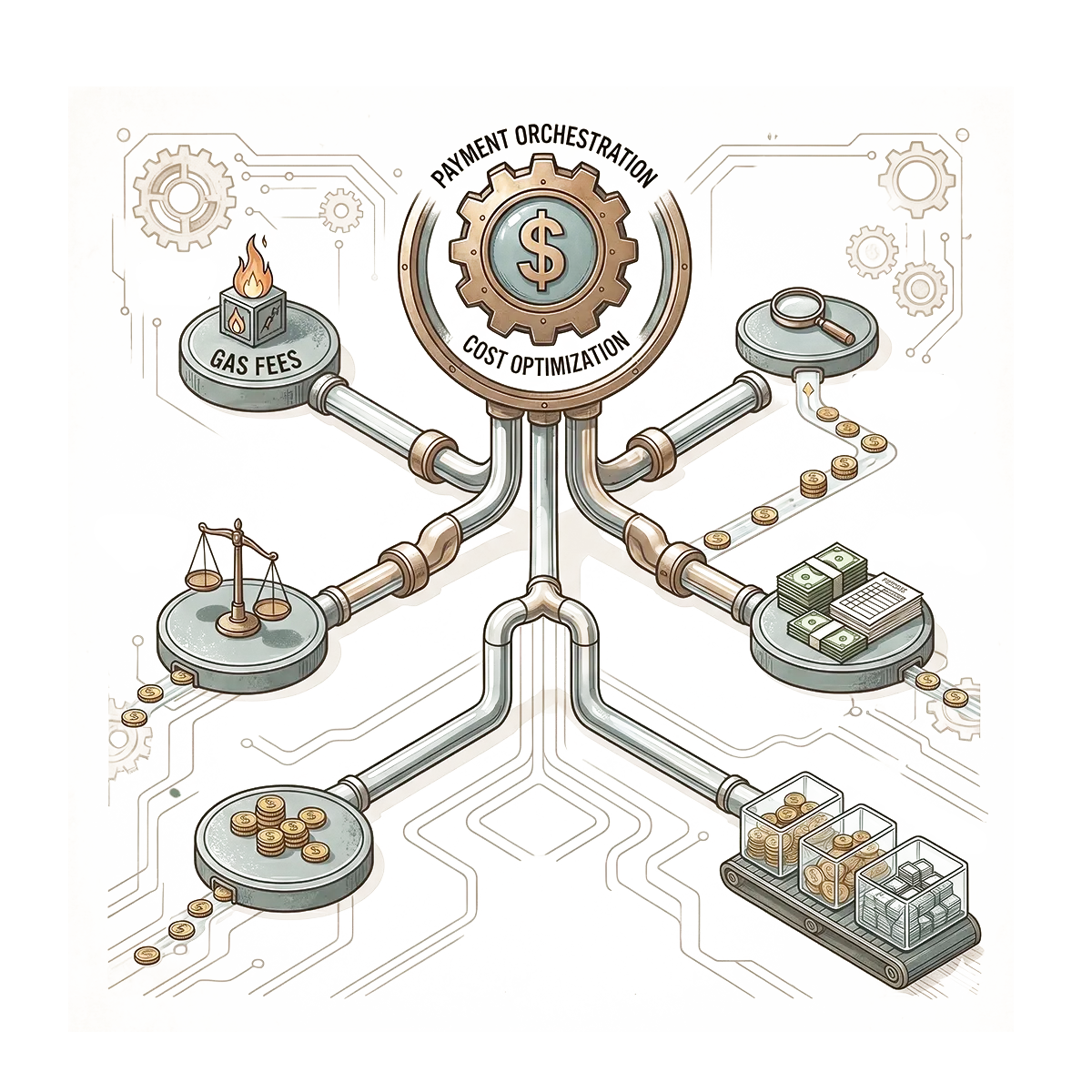
Unoptimized contracts can cost users $50-200 per transaction. Optimized contracts reduce this to $5-20. For high-volume applications, optimization isn't optional-it's the difference between a usable product and an expensive novelty.
Gas optimization involves storage pattern optimization like packing variables and minimizing SSTORE operations, computation reduction through precomputing values and caching, batch operations instead of individual transactions, efficient data structures and algorithms, and testing gas costs under various scenarios.
Basic optimization is usually included in development. Aggressive optimization where every gas unit counts adds 20-40% to development time. Extreme optimization for DeFi protocols where gas efficiency is critical can add 50-100% to development time.
For high-volume contracts, spending $20,000 on gas optimization can save users $200,000+ in gas fees over the contract's lifetime. The ROI is clear.
Upgradeability and Governance
Most production contracts need upgradeability. Building it correctly is complex and expensive, but essential for anything that will run for years.
Upgradeability options include proxy patterns like transparent proxies, UUPS, or beacon proxies. More complex is the diamond pattern for modular upgrades. You also need governance mechanisms for upgrade approval, time-locks and multi-sig controls, and emergency pause and upgrade procedures.
A basic proxy pattern adds 15-25% to development time. A governed upgrade system with voting and time-locks increases development by 30-50%. The complex diamond pattern can add 50-100% to development time.
For simple contracts with short lifespans, skip upgradeability. For anything complex or long-lived, it's essential. The alternative is deploying a new contract and migrating all users—far more expensive and risky than building upgradeability from the start.
Market Rate Ranges: What to Actually Expect
Based on current market rates, here are realistic total project costs including development, testing, audit, and basic infrastructure.
Simple Projects: $5,000 - $30,000
These projects deliver a standard ERC-20 or ERC-721 token with basic functionality using established patterns, one security audit, basic testing, a simple frontend for interaction, and deployment to one chain. Timeline is typically 4-8 weeks. Example projects include company tokens, basic NFT collections, or simple governance tokens.
Medium Complexity: $30,000 - $150,000
At this level you get custom token mechanics like staking, rewards, or vesting. You're building a multi-contract system with interactions between components. The project includes comprehensive testing and two audits, gas optimization, a production-grade frontend, multi-chain deployment capability, and monitoring with analytics. Timeline runs 8-16 weeks. Examples include staking protocols, NFT marketplaces, or DAOs with treasury management.
High Complexity: $150,000 - $500,000+
High-end projects involve novel DeFi mechanisms and complex multi-contract protocols. You get multiple audits and formal verification, extensive testing including bug bounties, advanced gas optimization, a full infrastructure stack, cross-chain functionality, and ongoing security monitoring. Timeline is 4-9 months. This category includes DEXs, lending protocols, derivatives platforms, and cross-chain bridges.
Enterprise/Institutional: $500,000+
At the enterprise level, you might be building custom blockchains or Layer 2 solutions. Projects require institutional-grade security, regulatory compliance features, extensive testing with multiple audits, complete infrastructure, long-term maintenance and support, and a dedicated development team. Timeline is 6-18+ months. Examples include asset tokenization platforms, institutional DeFi infrastructure, and regulated exchange systems.
What's Included (And What's Not)
Understanding scope is critical to accurate pricing. When you get a quote for smart contract development, certain things are typically included: the smart contract code itself, basic unit testing, code comments and documentation, deployment scripts, basic deployment to testnet and mainnet, and 30-60 days of bug fixes post-deployment.
However, many essential components are often not included and need to be clarified upfront. Frontend and UI development is usually separate. Backend API services, database setup and management, and off-chain integrations like payment processors or KYC systems are additional. Security audits often come as a separate contract. Post-launch monitoring and maintenance, feature additions after initial scope, support for multiple blockchains, and legal review with compliance work are all extras that add to the bottom line.
Always ask: "What exactly is included in this price?" Vague answers mean surprise costs later.
Hidden Costs Nobody Warns You About
Beyond the obvious development and audit costs, several hidden expenses catch projects off guard.
Gas costs for deployment can be significant. Deploying complex contracts to Ethereum mainnet can cost $5,000-50,000 in gas during high congestion. Deployment to Layer 2s or testnets is much cheaper, but mainnet costs are real and need to be budgeted.
Failed audits and rework are almost guaranteed. The first audit finds critical issues. You pay to fix them. Then you need a second audit to verify fixes. Sometimes a third audit because the second audit found new issues introduced by the fixes. Budget 20-30% extra for audit-driven rework.
Testnet iteration is time-consuming. You'll deploy to testnets 10-50 times during development. Each deployment needs testing. Each test might find issues requiring code changes. This iteration is essential but eats development hours.
Smart contract insurance through services like Nexus Mutual or InsurAce costs 2-5% of TVL annually. It's not required, but recommended for anything managing significant funds. For a protocol with $10M TVL, that's $200,000-500,000 per year in insurance costs.
Bug bounty programs pay white-hats to find vulnerabilities before black-hats do. Budget $50,000-500,000 depending on protocol value and complexity. This is much cheaper than losing funds to an exploit.
Ongoing monitoring requires 24/7 alerting and incident response capability. Setup costs $10,000-30,000. Ongoing costs run $2,000-10,000/month. When your protocol is managing millions, this isn't optional.
Emergency response retainers ensure experts are available when something breaks at 3 AM. Many firms charge $5,000-20,000/month for guaranteed emergency response. Without a retainer, you're competing for attention during crises.
Add 30-50% to your budget for these hidden costs. They're not really hidden - they're just poorly communicated during initial estimates.
DIY vs. Professional Development: When Each Makes Sense
The question of building in-house versus hiring external experts comes down to risk, timeline, and available talent.
DIY makes sense when you have experienced Solidity developers on staff, your project is low-risk like internal tools or proof-of-concept, you're building with standard well-tested patterns, timeline isn't critical, and you can afford learning curve mistakes. Cost savings are substantial - 50-70% compared to external firms. But hidden costs include longer timelines, higher bug risk, and your internal team being distracted from core business.
External firms make sense when you're handling real user funds or assets, security is critical, you need to launch quickly, your team lacks blockchain expertise, you need production-grade quality from day one, or regulatory compliance matters. The cost premium is real - 2-3x versus DIY. But benefits include faster delivery, lower risk, professional security, and no hiring overhead.
Many successful projects use a hybrid approach. Internal teams handle business logic and product development, but hire external specialists for security audits (always external), complex contract patterns like oracles or governance, gas optimization, cross-chain functionality, and initial architecture review. This balances costs while ensuring critical components are professional-grade.
How to Get an Accurate Quote
Most bad estimates come from bad briefs. If you want useful quotes from development firms, you need to provide clear information.
Start with clear functional requirements. What does the contract actually do? Who interacts with it and how? What are the core features, prioritized by importance? What data does it store and manage? The more specific you are, the more accurate the estimate.
Define security and compliance needs. What value will the contract manage? Any regulatory requirements? What are your security audit expectations? Do you need upgradeability? These factors can double or triple the cost, so they need to be clear upfront.
Specify technical constraints. What blockchain or blockchains are you targeting? Does it need to interoperate with other protocols? What are your gas cost constraints? Any specific performance requirements? Different chains have wildly different development costs.
Set timeline and budget expectations. When do you expect to launch? What's your budget range, even roughly? Is phased delivery acceptable? Knowing constraints helps firms propose realistic solutions.
Describe integration requirements. What frontend work is needed? Backend services? Off-chain data sources? Third-party integrations? These often cost more than the smart contracts themselves.
When evaluating quotes, watch for red flags. Avoid firms that give fixed prices without detailed discovery, promise unrealistically fast timelines, don't ask about security requirements, offer significantly below-market rates, can't show previous similar projects, don't discuss testing and audit plans, or provide vague scope documents.
Good firms will ask lots of questions, provide detailed scope documentation, break down costs by component, explain assumptions clearly, discuss risk factors openly, recommend appropriate security measures, and suggest phased approaches if applicable.
The Base58 Approach to Pricing
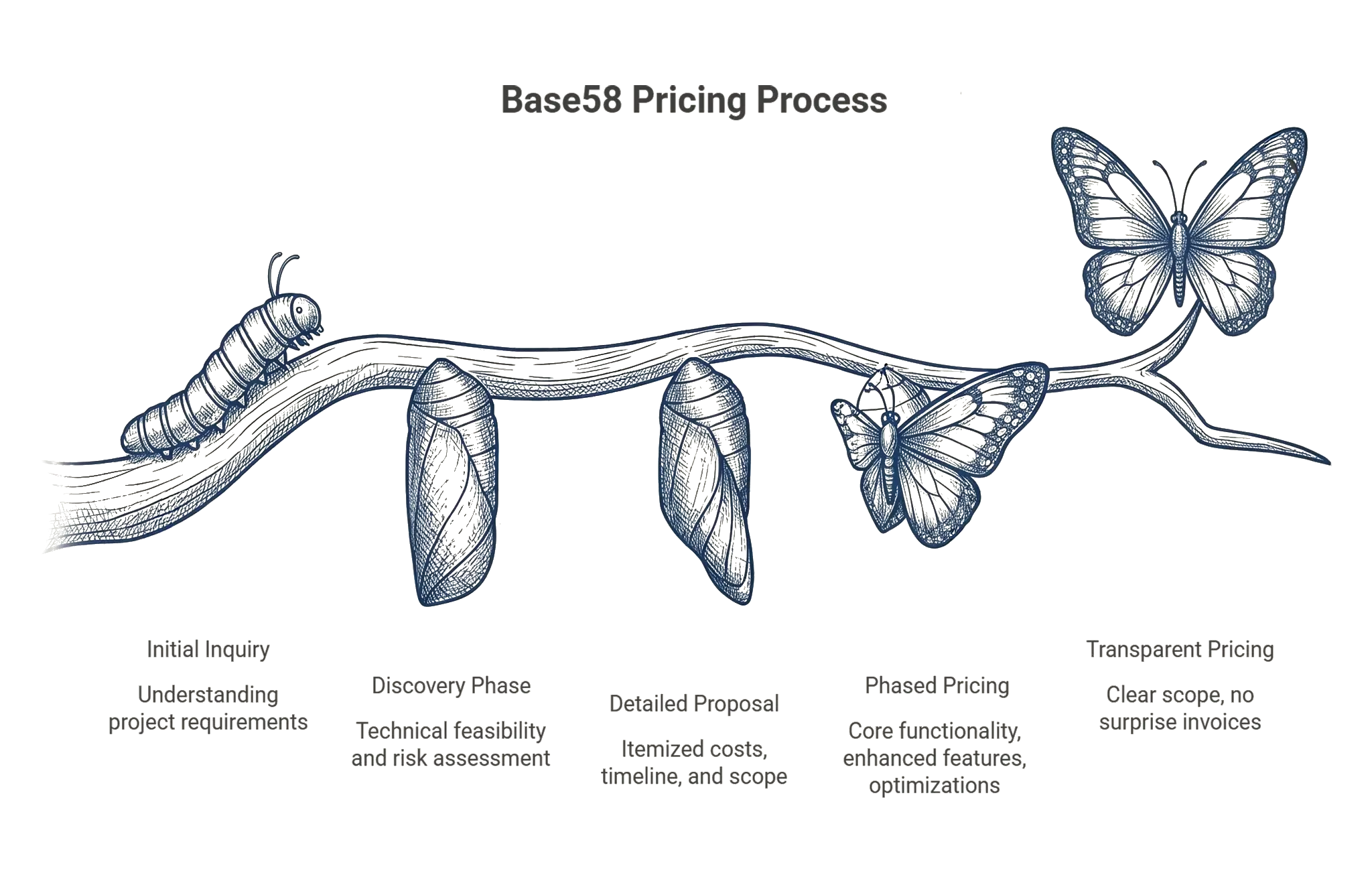
At Base58, we don't have a price list because no two smart contract projects are identical. Our pricing process is designed to give you accurate estimates based on your actual needs.
We start with a free discovery phase - a 1-2 hour consultation to understand your requirements, assess technical feasibility, provide preliminary architecture recommendations, and evaluate risk and complexity.
From there, we create a detailed proposal with itemized cost breakdown by component, a timeline with clear milestones, explicit scope definition, a security and testing plan, and clarity on what's included and what's not.
For larger projects, we often recommend phased pricing. Phase 1 delivers core functionality - the minimum viable contract. Phase 2 adds enhanced features. Phase 3 handles optimizations and polish. This lets you launch faster with core features while controlling costs.
We maintain transparent change management with a clear process for scope changes, impact assessment before implementing changes, and no surprise invoices.
We've built smart contracts ranging from $8,000 to $400,000+. The difference is always justified by complexity, security requirements, and scope - never arbitrary pricing.
Conclusion
"How much does a smart contract cost?" is like asking "how much does a building cost?" The answer is: it depends on whether you're building a garden shed or a skyscraper. A simple ERC-20 token contract? You can deploy one in an hour using OpenZeppelin templates for effectively free. A custom DeFi protocol with novel mechanisms, cross-chain functionality, and institutional-grade security? That's $200,000-500,000 and 6+ months of work.

Dariusz Wróbel
CEO