Real World Asset Tokenization: Complete Guide for Businesses
DAte
Category
Blockchain
Reading Time
6 min
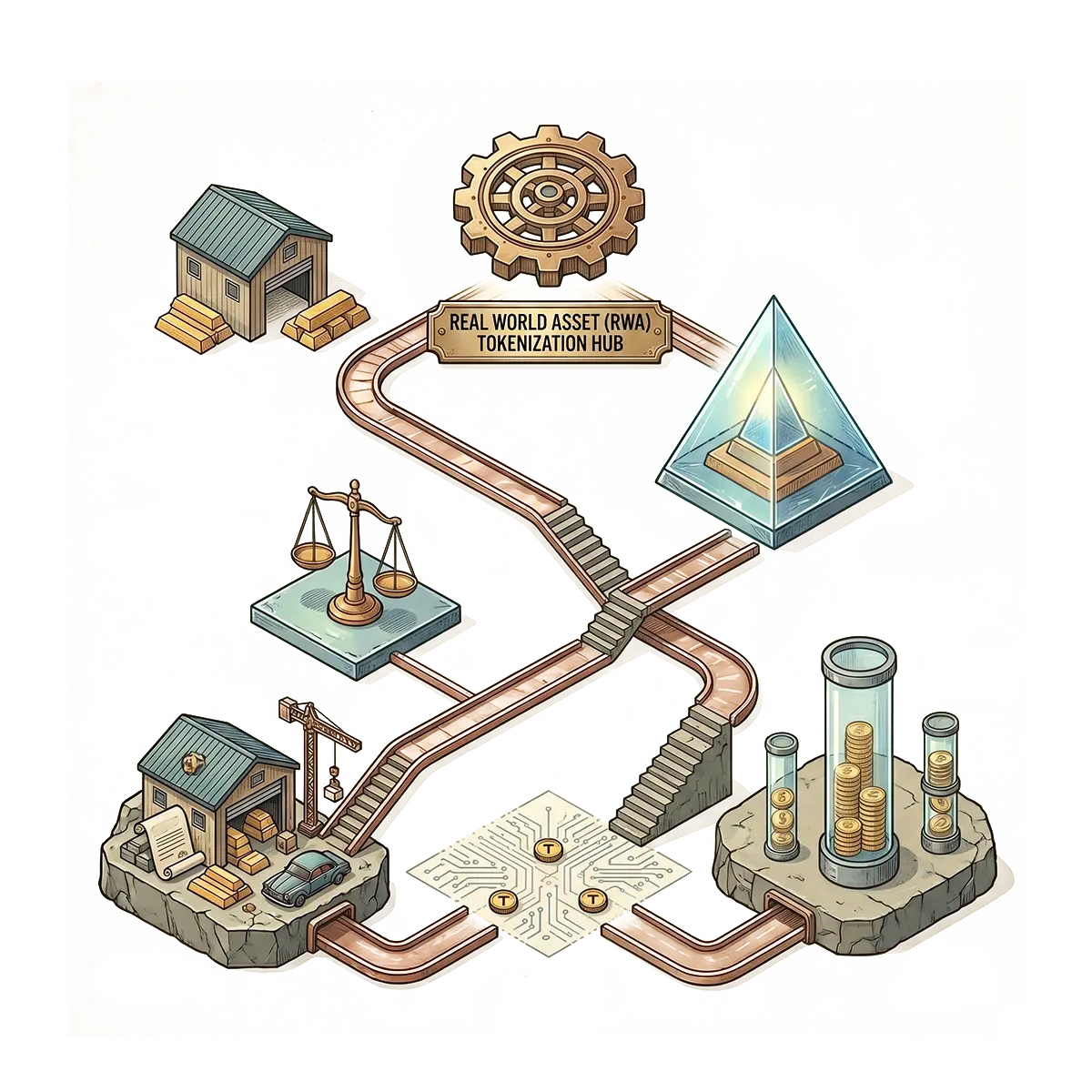
When BlackRock launches a tokenized money market fund, when JP Morgan settles repo transactions on blockchain, when the Singapore government issues tokenized bonds - this isn't experimentation anymore. Real world asset (RWA) tokenization is happening at institutional scale.
The premise is straightforward: take a physical asset - a building, a bond, a gold bar - and represent ownership as digital tokens on a blockchain. Each token proves fractional ownership. Tokens can be traded, transferred, used as collateral. The blockchain provides transparency, smart contracts automate compliance, and suddenly illiquid assets become tradable and divisible.
But between concept and implementation lies enormous complexity. Legal structures. Regulatory compliance. Technical architecture. Custody solutions. This guide breaks down how RWA tokenization actually works and what businesses need to know.
What Is RWA Tokenization (And Why Now)
RWA tokenization creates digital tokens representing ownership of physical assets. The token exists on blockchain, the asset in the real world, connected through legal agreements and smart contracts that enforce ownership rights.
Why now? BlackRock's BUIDL fund holds over $2 billion in tokenized treasuries. Franklin Templeton's money market fund has been on-chain since 2021. Siemens issued digital bonds. These aren't pilots - they're production systems managing billions.
Four factors converged to make this possible. Regulatory frameworks are emerging - MiCA in Europe, proposed frameworks in the US and Asia provide clarity. Infrastructure matured with institutional custody solutions, compliant blockchain networks, and KYC/AML providers. Economic incentives became clear as tokenization removes friction, reduces costs, and enables new business models. The technology stabilized - Ethereum is proven, Layer 2 solutions work, smart contract security is understood.
What Assets Can Be Tokenized
Almost anything of value, but practically, assets where tokenization solves real problems.
Real Estate is the obvious candidate. Properties are expensive and illiquid. Tokenization enables fractional ownership - $10M buildings become accessible at $10K. Commercial real estate works well with clear cash flows. The challenge is legal structure - you're tokenizing shares in an entity that owns the building, not the building itself.
Fixed Income and Bonds are perfect for tokenization. They're already digital, settlement is slow and expensive, secondary markets lack liquidity. Siemens issued €60M in tokenized bonds. The European Investment Bank issued €100M. Regulatory clarity exists because bonds are well-understood instruments.
Commodities like gold, silver, and oil can be tokenized with tokens representing ownership of physical goods in custody. Paxos Gold tokenizes gold with each token backed by one troy ounce in vaults. The challenge is custody and verification.
Intellectual Property - patents, royalties, copyrights - can be tokenized. Musicians tokenize future royalties, letting fans invest. Legal complexity is significant, but for revenue-generating IP, it creates new funding models.
Private Equity tokenization doesn't eliminate lock-ups but can create secondary markets for accredited investors. Better price discovery and some liquidity in otherwise frozen positions.
Collectibles and Art become accessible through fractional ownership. Masterworks tokenizes art, Rally does collectibles. The challenge is subjective valuation and illiquid underlying markets.
How It Works Technically
At the core, a token is a smart contract maintaining a registry of who owns how many tokens. Transfer tokens, the contract updates the registry. The blockchain ensures this is tamper-proof and transparent.
RWA tokens are more complex than cryptocurrencies. They enforce compliance rules - only accredited investors can hold them, transfers must comply with securities regulations, distributions happen automatically. All encoded in smart contracts.
Token standards matter. ERC-20 works for fungible tokens but lacks compliance features. ERC-1400 adds security token features - transfer restrictions, forced transfers for legal requirements, document management. For regulated securities, security token standards are essential.
Compliance infrastructure connects traditional identity verification with blockchain permissioning. KYC/AML verification happens off-chain, results feed on-chain whitelists. Only verified addresses can hold or receive tokens.
Corporate actions - dividends, interest payments - need automation. Smart contracts distribute payments proportionally, but funding requires connecting on-chain tokens to off-chain revenue, typically through stablecoins.
Secondary market trading happens on-chain with compliance checks at every transfer. The smart contract verifies sender and receiver are whitelisted before allowing transfer.
On-Chain vs Off-Chain Ownership Models
A critical distinction that determines architecture, legal structure, and regulatory treatment.
On-Chain Ownership: The token is the ownership. If you hold the token, you own the asset. Works for native digital assets like Bitcoin or NFTs. For RWAs, pure on-chain ownership is rare because legal systems don't recognize blockchain as authoritative for physical assets. Some jurisdictions are moving toward recognition - Wyoming allows DAOs to own property - but this model remains limited.
Off-Chain Ownership with On-Chain Representation: Ownership lives in traditional legal structures - an SPV, trust, or corporation. The token represents fractional ownership in that entity.
Example: tokenizing a $10M commercial property. Create an LLC that owns the building. Issue 10,000 tokens, each representing 0.01% LLC ownership. Token holders are LLC members with proportional rights to rental income. The LLC agreement recognizes token transfers as valid ownership changes.
Legal ownership is in the LLC. Token ownership is on blockchain. Connected through legal agreements. This is the dominant model because it provides legal certainty and regulatory compliance while delivering blockchain benefits.
Legal and Regulatory Requirements
Tokenizing real world assets means navigating securities law, which is complex and jurisdictional.
The fundamental question: is your token a security? If it represents ownership of an asset generating returns, it's a security in most jurisdictions. Real estate tokens, tokenized bonds - definitely securities.
If it's a security, you need compliance. In the US, that means SEC registration or qualifying for an exemption - Regulation D for private placements, Regulation A for limited public offerings, Regulation S for offshore. Europe has MiCA. Asia varies by country.
SPV structure is almost always required. Create a special purpose vehicle that owns the asset. Tokens represent ownership in the SPV. The SPV's legal documents specify token holder rights, governance, and distributions.
KYC/AML compliance is mandatory. Verify investor identity, check sanctions lists, monitor for suspicious activity. Integration with compliance providers is essential.
Transfer restrictions are encoded in smart contracts. Securities regulations limit who can buy and sell - only accredited investors, holding periods, geographic restrictions. Smart contracts enforce these automatically.
Getting legal structure wrong can mean fines, disgorgement of profits, criminal liability. Work with lawyers who understand both securities law and blockchain.
Technical Infrastructure Stack
Building a tokenization platform requires complete infrastructure spanning blockchain, compliance, custody, and traditional finance integration.
Choose the right blockchain network. Ethereum mainnet offers security and liquidity but high gas costs. Layer 2 solutions provide lower costs with slightly different security models. Permissioned chains offer privacy but sacrifice public blockchain benefits.
Token standard selection is critical. ERC-20 lacks compliance features. ERC-1400 adds transfer restrictions, forced transfers, and document management essential for regulated securities.
Compliance infrastructure connects identity verification with blockchain permissioning. KYC/AML results feed on-chain whitelists controlling who can hold tokens.
Smart contracts handle corporate actions, compliance rules, and governance. Dividend distribution happens automatically. Governance features enable token holder voting. Pause mechanisms provide emergency controls.
Custody solutions secure underlying assets. Physical assets need trusted custodians. Digital representations need institutional-grade key management - multi-sig wallets or custody solutions like Fireblocks.
Secondary market infrastructure enables compliant trading. Proprietary platforms, security token exchanges, or peer-to-peer trading with automated compliance checks - each has tradeoffs.
Frontend interfaces must abstract blockchain complexity while maintaining security. Most users don't want to manage private keys. Social recovery, gasless transactions, or custodial approaches make it accessible.
Creating Secondary Market Liquidity
Tokenization without liquidity misses the point. But creating actual markets requires strategy.
Traditional securities exchanges won't list your tokens - you need alternatives. Proprietary platforms create dedicated marketplaces for specific token classes. Security token exchanges like tZERO provide infrastructure for compliant trading. Private markets enable peer-to-peer trading with smart contract compliance enforcement.
Market makers provide liquidity by quoting spreads and standing ready to trade. This requires sufficient volume and proper incentives.
The reality: early-stage projects struggle with liquidity. Beautiful fractional real estate ownership means nothing if there's no one to sell to. Building liquidity requires critical mass of participants, which takes time.
Bootstrap strategies include starting with closed networks, providing liquidity incentives initially, ensuring minimum viable market size before launch, and creating fundamental value that makes holding attractive even without immediate liquidity.
Implementation Roadmap
Successfully launching a tokenization platform requires methodical execution.
Proof of Concept (2-3 months, $50K-150K): Choose a specific asset to tokenize. Build minimum viable smart contracts. Test with closed group. Validate legal structure. Measure actual costs and timelines. Goal is learning, not perfection.
Legal Structuring (3-6 months, $100K-500K): Structure the SPV, draft token holder agreements, prepare offering documents, obtain regulatory approvals, establish custody. Don't skimp - legal failures destroy projects.
Platform Development (4-9 months, $200K-1M): Develop audited smart contracts, build investor interfaces, integrate KYC/AML systems, set up custody infrastructure, create monitoring systems, implement security measures.
Pilot Issuance (2-4 months): Tokenize initial assets with limited investors. Execute end-to-end process. Test secondary trading. Gather feedback. Keep it limited - $1-5M in assets rather than going big.
Public Launch: Scale to broader market. Process larger KYC volumes. Manage increased tokenization. Provide liquidity mechanisms. Deliver ongoing compliance.
Total investment: $500K-2M over 12-24 months for most projects.
What Base58 Brings to RWA Tokenization
Building RWA tokenization platforms is complex blockchain-plus-traditional-finance integration that Base58 specializes in. We've worked on tokenization projects across real estate, securities, and commodities.
We start with business model validation. Does tokenization solve a problem for your assets and investors? What's the realistic market size? We've seen projects fail because the business case was weak despite solid technology.
We handle the complete technical stack - smart contracts with security token standards, KYC/AML compliance integration, custody solutions, secondary market infrastructure, and monitoring systems.
We build for scale from day one. Your pilot might tokenize one property, but the platform needs to handle hundreds. Architecture must work at pilot scale but survive growth.
Regulatory compliance is built into every layer. Transfer restrictions in smart contracts. Automated verification before trades. Audit trails for reporting. We understand compliance isn't an afterthought - it's core to the product.
Conclusion
RWA tokenization is transitioning from experiment to institutional infrastructure. When BlackRock, JP Morgan, and Siemens tokenize assets, when governments issue digital bonds - this validates the technology and business case. At Base58, we build RWA tokenization platforms that handle this correctly. We've implemented legal structures, built compliant smart contracts, integrated custody solutions, and created secondary market infrastructure. The technology is ready. The regulations are emerging. The market is growing. What's needed is proper execution - and that's what we do.

Leo Park
Blockchain Expert