How Zero-Knowledge Tech Scales Blockchain
DAte
Category
Blockchain
Reading Time
5 Min
Everyone thinks zero-knowledge proofs are about hiding things.
That's the wrong mental model. Yes, ZK proofs power privacy coins. Yes, they can obscure transaction amounts and wallet addresses. But the reason the entire blockchain industry is betting on ZK technology has almost nothing to do with hiding anything.
It has everything to do with verification.
The fundamental breakthrough of ZK proofs isn't privacy — it's the ability to prove that complex computation happened correctly without redoing that computation. That distinction sounds subtle. It isn't. It changes everything about how blockchains scale.
The Problem With "Everyone Verifies Everything"
Blockchain's security comes from replication. Every node on the Ethereum network re-executes every transaction independently. If most nodes agree, the transaction is valid. This works — but it's also why Ethereum is slow.
You can't have maximum decentralization and massive throughput with a model built on "everyone re-executes everything." For fifteen years, the industry has been trying to solve this without breaking the security model. Most attempts made tradeoffs: faster chains that sacrifice decentralization, sidechains that introduce trust assumptions, bridges that get hacked.
ZK-rollups are the first approach that genuinely doesn't break the model.
What a ZK Proof Actually Does
Here's the core insight, stripped of jargon:
Executing a computation is expensive. Verifying that a computation was done correctly can be dramatically cheaper — if you have the right mathematical tools.
A zero-knowledge proof says: "I ran these 10,000 transactions. Here's a tiny proof that I did it correctly. You can verify this proof in milliseconds, without re-running a single transaction."
Ethereum doesn't re-execute anything. It just checks the proof. Valid proof means valid transactions. The security is mathematical, not reputational.
This is the game-changer. Not the privacy. The compression of trust.
ZK-Rollups and ZK-EVMs in Practice
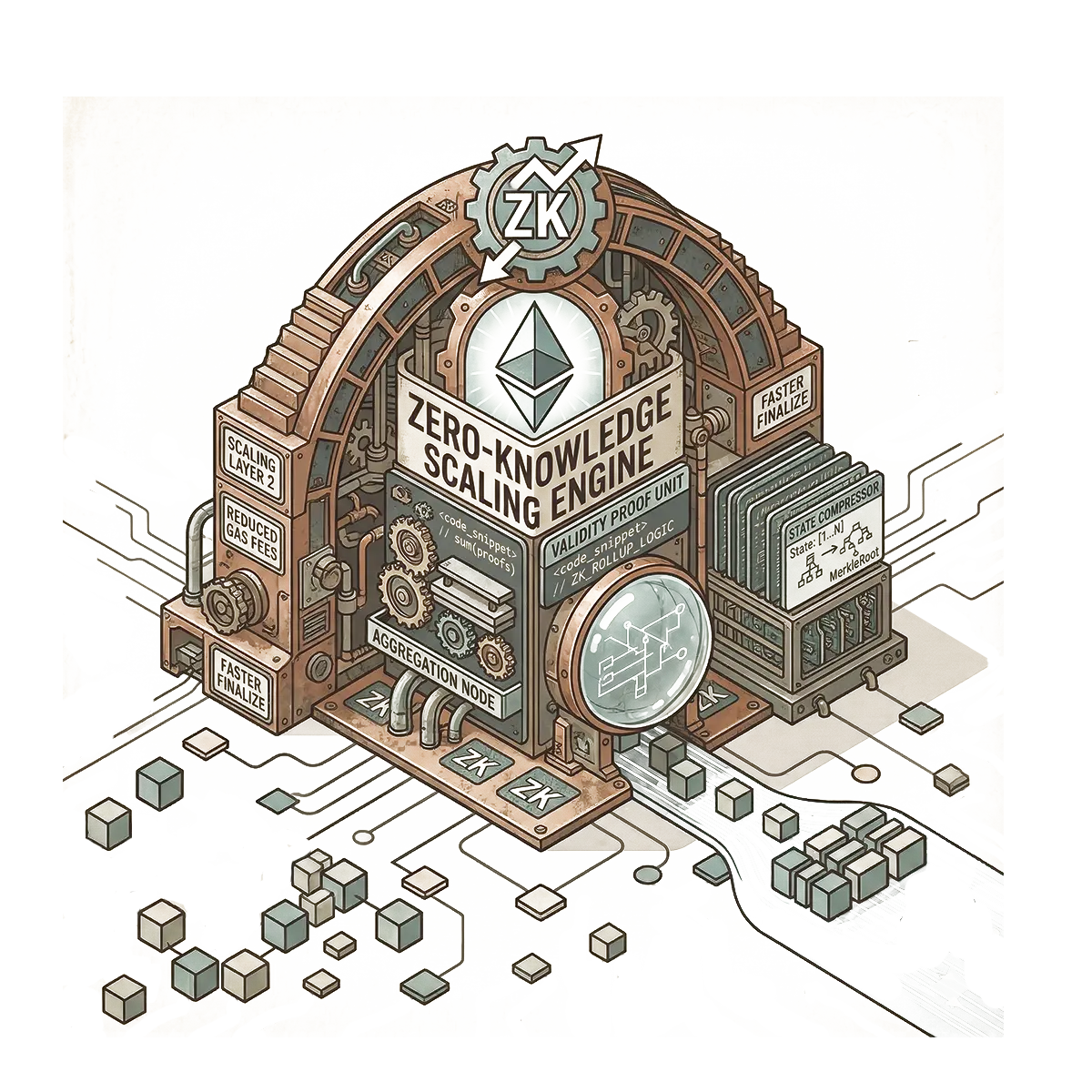
A ZK-rollup collects thousands of transactions off-chain, executes them, generates a cryptographic validity proof, and posts that proof to Ethereum mainnet. Ethereum checks the proof — not the transactions themselves. Result: throughput scales by orders of magnitude while Ethereum's security guarantees stay intact.
ZK-EVMs take this further. They run transactions in an environment fully compatible with Ethereum's execution model and generate a validity proof for every step. That means existing smart contracts — Uniswap, Aave, whatever you've built — deploy on a ZK-rollup without modification. Existing developer tools. Existing audited code. No rewrite needed.
zkSync Era, Polygon zkEVM, Scroll, Linea — all ZK-EVMs in production today, processing real transactions with real value.
Why This Is Bigger Than Privacy Coins
Privacy coins are a niche market. ZK proofs as scaling infrastructure affect everyone who uses any blockchain application.
DeFi at scale: High-frequency protocols need throughput Ethereum mainnet can't provide. ZK-rollups give them Ethereum settlement security with speeds competitive with centralized systems.
Gaming and consumer apps: A game where every action costs $0.50 in gas isn't a game anyone plays. With ZK-rollups, transactions cost fractions of a cent and confirm in under a second.
Cross-chain verification: ZK proofs can verify events on another chain without replaying its entire history — the foundation for trust-minimized bridges that don't require 7-day withdrawal periods.
Verifiable off-chain computation: Run complex calculations off-chain — ML inference, financial modeling, data aggregation — and prove the result was computed correctly. The blockchain verifies the proof, not the computation.
The Honest Part: It's Not Perfect Yet
ZK-rollups aren't plug-and-play. Proof generation is computationally intensive and adds latency. Most production rollups still rely on semi-centralized provers — they can't steal funds, but they can censor transactions or go offline. Decentralized prover networks are in active development, but not fully there yet.
The tooling is maturing fast. The economics are improving every year. But if you're building production infrastructure today, these are real constraints to design around — not surprises to discover later.
The Shift That's Already Happening
ZK proofs are doing to blockchain verification what compilers did to programming.
Before compilers, you wrote machine code by hand. Compilers abstracted that away — you write high-level code, the compiler handles the complexity, the result is faster to build and easier to verify.
ZK proofs build that same abstraction layer for blockchain verification. You execute transactions in a familiar environment. The prover handles the cryptographic complexity. Ethereum verifies the result. Not less secure — more scalable.
The blockchain scalability problem isn't solved by making base layers faster or sacrificing decentralization. It's solved by proving computation rather than re-executing it.
At Base58, we build blockchain systems for production. ZK-rollups are becoming foundational infrastructure — the kind of thing you design around from the beginning, not retrofit later. The math is elegant. The implementation is hard. The results are worth it.
Conclusion
Building on blockchain in 2026 means making architectural decisions that will matter for years. ZK-rollups are no longer experimental. They're in production, processing real value, and reshaping what's possible on top of Ethereum. If you're designing a system that needs scale, security, and long-term viability — the ZK stack deserves a serious look from day one. At Base58, we help teams navigate these decisions without the guesswork.

Leo Park
Blockchain Expert