On-Chain vs Off-Chain Architecture: What Should Live Where?
DAte
Category
Blockchain
Reading Time
10 Min
Here's a conversation that happens in every blockchain project, usually around week three:
Developer: "Should we store the user profile pictures on-chain?"
Architect: "Absolutely not."
Developer: "But isn't blockchain supposed to be decentralized and immutable?"
Architect: "Yes. Which is why storing 10MB images on-chain would cost users $5,000 per upload and make every node store terabytes of jpeg data forever."
Developer: "Oh."
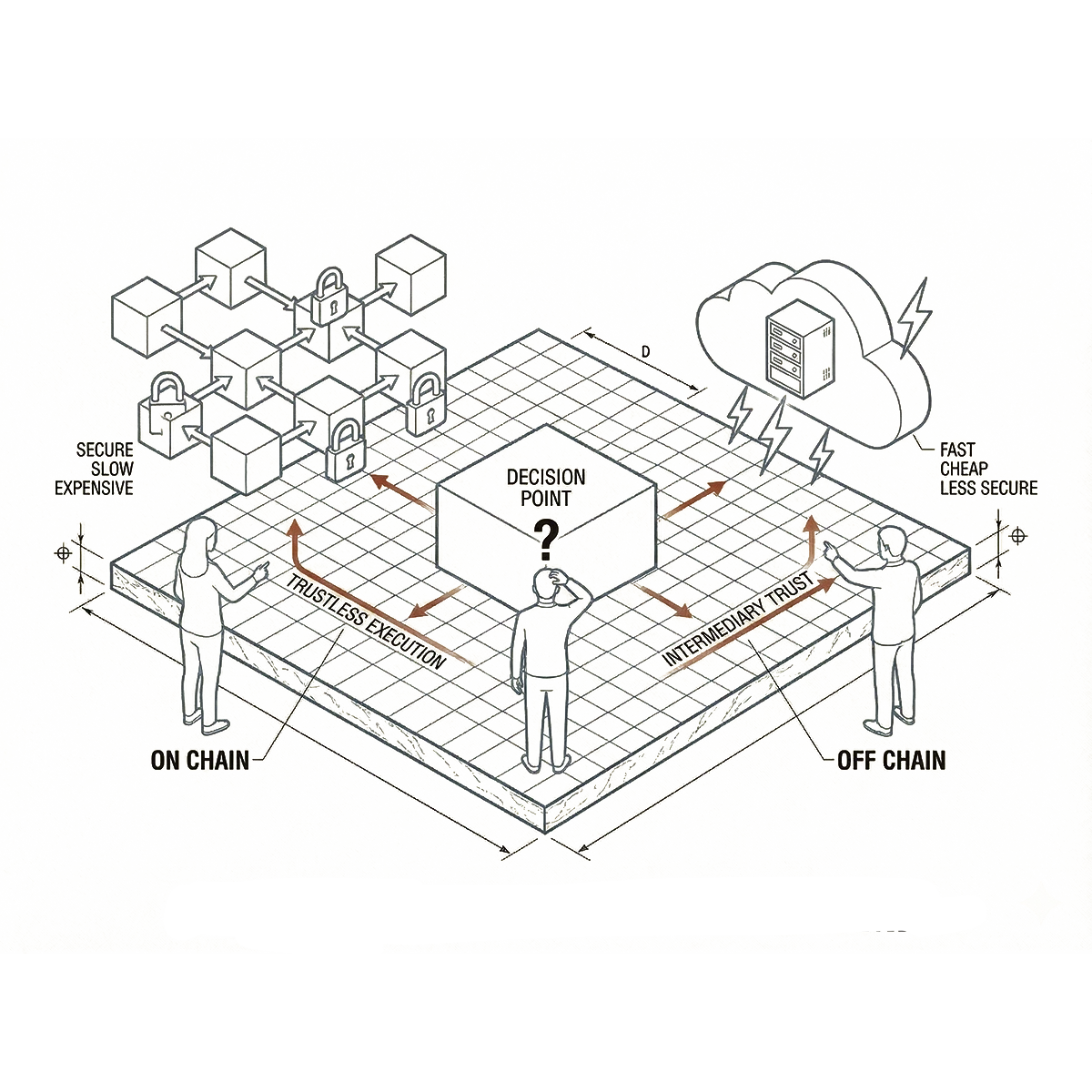
Welcome to the fundamental tension in blockchain architecture: the gap between theoretical purity and practical reality. Everything on-chain would be maximally decentralized, verifiable, and censorship-resistant. It would also be prohibitively expensive, impossibly slow, and absurdly inefficient.
The real skill in blockchain engineering isn't building systems that are 100% on-chain—it's building systems that put exactly the right things on-chain and everything else off-chain, in ways that preserve the properties you actually need while remaining usable and economical.
Let's talk about how to make these decisions correctly, because getting this wrong is expensive—both in development costs and in the user experience disasters that follow.
Understanding What "On-Chain" Actually Means
When data lives on-chain, it means:
Every node stores it forever. Not just your node. Every full node in the network. If you put 1GB of data on Ethereum, you're asking thousands of nodes globally to store that gigabyte permanently. The network doesn't forget. Ever.
Every transaction that touches it costs gas. Reading data is free (for users). Writing data costs money. How much depends on how much data you're writing and how expensive gas is that day. A complex smart contract interaction can easily cost $50-200 in gas during network congestion.
It's public and permanent. Anyone can read it. Anyone can analyze it. You can't delete it or edit it (without deploying new contracts and migrating state). Privacy isn't really an option unless you're using specialized privacy chains.
It's verifiable by anyone. This is the upside. Anyone can verify the data's authenticity and integrity. You don't need to trust a database administrator or a company's servers. The blockchain guarantees the data is what it claims to be.
It's censorship-resistant. No single entity can delete it, modify it, or prevent access to it. This matters enormously for some use cases and not at all for others.
When you're deciding what goes on-chain, you're deciding what needs these properties—and what you're willing to pay (in cost and complexity) to get them.
Understanding What "Off-Chain" Actually Means
Off-chain data lives in traditional databases, cloud storage, IPFS, or other non-blockchain systems. This means:
It's fast and cheap. No gas costs. No waiting for block confirmations. Updates happen instantly. Storage costs pennies, not dollars per kilobyte.
It's mutable. You can edit it, delete it, update it without deploying new smart contracts or paying gas fees. This flexibility is essential for most real-world applications.
It requires trust (usually). Someone controls the servers. Someone can modify the data. Someone can shut down access. You're back to trusting intermediaries—though there are ways to mitigate this.
It can be private. Traditional access controls work. You can have user authentication, permissions, data encryption. Personal data can comply with privacy regulations like GDPR.
It scales easily. Need to store a million user profiles? No problem. Need to process thousands of reads per second? Standard database architecture handles this trivially.
The challenge with off-chain data is maintaining the security and trust properties you need while getting the performance and cost benefits. This is where architecture gets interesting.
The Core Decision Framework
Before deciding where data lives, ask these questions:
Does this data need to be trustlessly verifiable?
If multiple parties need to verify data authenticity without trusting each other or a central authority, it probably belongs on-chain. If one party can be trusted (or verified through traditional means), it can live off-chain.
Does this data change frequently?
High-frequency updates are painful on-chain. Every change costs gas and takes time. If data updates constantly (user activity logs, real-time metrics, frequently changing state), keep it off-chain.
How large is this data?
Tiny data (addresses, hashes, small numbers) can live on-chain affordably. Large data (images, documents, detailed records) is prohibitively expensive on-chain. Use the blockchain to store references (hashes) to off-chain data instead.
Does this data need to be permanent?
Blockchain storage is forever. If you need true permanence and can't afford data loss, on-chain works. If data can be archived or deleted later, off-chain gives you flexibility.
How sensitive is this data?
Personal information, private business data, anything subject to privacy regulations—this probably can't live on public blockchains. Off-chain with traditional privacy controls makes more sense.
What's your budget for storage and transactions?
Gas costs are real. If you're building a high-volume application where users perform dozens of actions daily, putting everything on-chain will make your app unusable due to cost.
Base58 (base58.io) works through this framework with every client because the on-chain/off-chain balance fundamentally determines project feasibility, cost structure, and user experience. Getting it wrong means rebuilding architecture months into development.
Common Patterns That Work
Let's look at proven architectural patterns for hybrid on-chain/off-chain systems:
Pattern 1: On-Chain Registry, Off-Chain Data
What goes on-chain: Hashes of off-chain data, ownership records, timestamps
What stays off-chain: Actual content (images, documents, large datasets)
How it works: Store a cryptographic hash of the data on-chain. Store the actual data off-chain (IPFS, cloud storage, dedicated servers). Anyone can verify off-chain data matches the on-chain hash.
Example: NFT metadata. The token ownership lives on-chain. The actual image and properties live on IPFS. The on-chain token points to the IPFS hash. You get verifiable ownership without storing megabytes of image data on expensive blockchain storage.
Why it works: You get the verification and ownership benefits of blockchain without the storage costs. Users can prove data hasn't been tampered with by comparing hashes.
Pattern 2: On-Chain Anchoring, Off-Chain Computation
What goes on-chain: Critical state transitions, final results, proofs
What stays off-chain: Heavy computation, intermediate steps, complex calculations
How it works: Perform complex operations off-chain. Submit only the final result and a proof to the blockchain. The chain verifies the proof and updates state accordingly.
Example: Zero-knowledge rollups. Thousands of transactions processed off-chain, compressed into a single proof that's verified on-chain. Massive scalability increase because the expensive computation happens off-chain.
Why it works: Blockchain verification is much cheaper than blockchain computation. You maintain security guarantees while achieving practical performance.
Pattern 3: On-Chain Assets, Off-Chain Marketplace
What goes on-chain: Token ownership, transfers, final settlement
What stays off-chain: Order books, matching engines, user interfaces
How it works: Users create orders off-chain (signed messages, not transactions). The marketplace matches buyers and sellers off-chain. Only the final trade settles on-chain as an actual token transfer.
Example: OpenSea and similar NFT marketplaces. You can browse millions of listings, update prices, make offers—all off-chain and instant. Only when you actually buy something does an on-chain transaction occur.
Why it works: Users get instant feedback and rich functionality without paying gas for every interaction. Settlement security remains on-chain where it matters.
Pattern 4: Hybrid State with Merkle Proofs
What goes on-chain: Merkle root of the current state
What stays off-chain: Complete state data, full transaction history
How it works: Maintain complete state off-chain in a database. Compute a Merkle root of that state and post it on-chain periodically. Users can prove their balance or state using Merkle proofs without the chain storing everyone's data.
Example: Plasma chains and many layer-2 solutions. Child chains process transactions rapidly off-chain. Periodically, they commit the state root to Ethereum mainnet. Users can prove their balances using Merkle proofs.
Why it works: Massive storage savings while maintaining verifiability. The blockchain becomes an anchor point rather than a complete database.
What Typically Goes On-Chain
Based on thousands of production blockchain systems, here's what usually belongs on-chain:
Ownership Records: Who owns which tokens, NFTs, or assets. This is the core value proposition—trustless ownership verification.
Financial Transfers: Sending money, swapping tokens, settling trades. These need to be atomic, verifiable, and irreversible.
Access Control: Who has permission to do what. Smart contract-based authorization that can't be overridden by admins.
Critical State Transitions: Governance votes, protocol upgrades, major system changes. Things where transparency and immutability matter most.
Commitments and Proofs: Hashes of off-chain data, zero-knowledge proofs, attestations. Small data that anchors larger off-chain systems.
Time-Stamping: Proving something existed at a specific time. Blockchain timestamps are trustless and permanent.
Notice what's not on this list: user profiles, activity logs, metadata, images, documents, analytics, caching, session data. That's intentional.
What Typically Stays Off-Chain
Here's what almost always belongs in traditional infrastructure:
Large Media Files: Images, videos, audio. Store on IPFS, Arweave, or cloud storage. Reference them on-chain via hash.
Personal Information: Names, emails, addresses, phone numbers. Privacy regulations require this stays off-chain with proper access controls.
High-Frequency Data: Real-time prices, live activity feeds, constantly updating metrics. Too expensive to put on-chain.
Complex Computations: Machine learning, heavy algorithms, data analysis. Compute off-chain, put results on-chain.
User Interface State: Session data, UI preferences, cached data. Pure frontend concerns that don't need blockchain.
Search and Indexing: Full-text search, complex queries, aggregations. Use The Graph or custom indexers to make blockchain data queryable.
Historical Archives: Old transactions, inactive accounts, deprecated data. Archive off-chain to prevent state bloat.
Professional blockchain systems from firms like Base58 use off-chain infrastructure for 80-90% of the data and computation, with the blockchain serving as the trust anchor for the critical 10-20% that actually needs it.
The IPFS Middle Ground
IPFS (InterPlanetary File System) deserves special mention as a hybrid solution. It's technically off-chain, but it offers some blockchain-like properties:
Content-addressed storage: Files are referenced by their cryptographic hash. If the content changes, the hash changes. This provides tamper-evidence.
Distributed: Data lives on multiple nodes. No single point of failure.
Permanent (ish): Data persists as long as someone pins it. Services like Pinata and Infura offer permanent pinning.
Not a blockchain: No consensus, no guaranteed permanence, no transaction costs. Much cheaper than on-chain storage.
IPFS works well for NFT metadata, document storage, and large datasets that need content verification but don't need to live on expensive blockchain storage. You store the IPFS hash on-chain, creating a permanent reference to verifiable off-chain data.
The Cost Reality Check
Let's talk actual numbers because this is where theoretical purity meets financial reality.
Ethereum Storage Costs (approximate):
Storing 1KB on-chain: ~$20-50 depending on gas prices
Storing 1MB on-chain: ~$20,000-50,000
Storing 1GB on-chain: Effectively impossible at scale
Traditional Storage Costs:
Amazon S3: $0.023 per GB per month
IPFS pinning services: ~$0.15 per GB per month
Traditional databases: Pennies per GB
The math is brutal. A simple user profile with a 100KB photo would cost hundreds of dollars to store on-chain. That same data costs fractions of a cent off-chain.
When Base58 architects blockchain systems, cost modeling is immediate. How many users? How much data per user? How many transactions per day? The numbers determine architecture because if your design requires users to pay $100 in gas fees to create a profile, you don't have a viable product.
Security Considerations for Hybrid Architectures
Mixing on-chain and off-chain data creates security challenges you need to address:
Data Availability: If critical data lives off-chain, what happens when those servers go down? You need redundancy, backups, and ideally multiple independent data sources.
Oracle Trust: When on-chain smart contracts need off-chain data, you use oracles. But oracles are trusted entities—they can lie. Use multiple oracles, reputation systems, and economic incentives to ensure honesty.
State Consistency: On-chain and off-chain state can diverge. Your architecture needs mechanisms to detect and resolve inconsistencies.
Verification Gaps: Users should be able to verify off-chain data matches on-chain commitments. Provide tools and documentation for verification.
Access Control: Off-chain data requires traditional security. Hacking a database that backs your blockchain app is just as damaging as exploiting a smart contract.
Professional implementations include comprehensive monitoring, automated reconciliation between on-chain and off-chain state, and clear procedures for handling discrepancies.
The Migration Challenge
One underappreciated complexity: moving data between on-chain and off-chain storage as your architecture evolves.
Scenario: You launched with data on-chain because you had 100 users and gas was cheap. Now you have 100,000 users and gas is 10x higher. You need to move data off-chain.
This requires:
Deploying new smart contracts with updated architecture
Migrating existing on-chain data to off-chain storage
Updating all user interfaces and integrations
Maintaining backwards compatibility during transition
Convincing users to migrate (if they need to take action)
Plan your architecture for scale from day one. Moving from off-chain to on-chain is expensive but possible. Moving from on-chain to off-chain is technically complex and often requires complete system redesigns.
Base58 designs systems with migration paths built in because requirements change, gas prices fluctuate, and what works at 1,000 users breaks at 100,000.
Layer-2 Solutions: The Best of Both Worlds?
Layer-2 solutions attempt to give you on-chain security with off-chain performance:
Rollups (Optimistic and ZK): Process transactions off-chain, post compressed data and proofs to mainchain. Much cheaper than mainchain while maintaining security.
State Channels: Conduct unlimited transactions off-chain between parties, settle final state on-chain. Near-instant, near-free transactions.
Sidechains: Separate blockchains with their own consensus, periodically anchoring to mainchain. More centralized but much faster and cheaper.
Plasma: Hierarchical tree of child chains, each anchoring to its parent. Scales well but adds complexity.
These solutions live in the gray area between pure on-chain and pure off-chain. They're getting better, but they add architectural complexity, require specialized expertise, and introduce new trust assumptions.
For many applications, the right answer is still: critical stuff on mainchain, everything else in traditional infrastructure, with layer-2 as an optimization for specific bottlenecks.
Making the Right Choice for Your Project
There's no universal answer. The right architecture depends on your specific requirements:
Financial Applications (DeFi): Critical financial state on-chain. Order books and matching off-chain. Settlement on-chain.
NFT Platforms: Ownership on-chain. Metadata and images on IPFS. Marketplace features off-chain.
Gaming: Core assets and economy on-chain. Game state and physics off-chain. Use blockchain for items and currency, not for every game tick.
Supply Chain: Key checkpoints and transfers on-chain. Detailed product data and documentation off-chain with hash references.
Identity Systems: Identity proofs and attestations on-chain. Personal details off-chain with user-controlled access.
DAOs: Governance votes and treasury operations on-chain. Discussions and proposals off-chain.
The pattern is consistent: use blockchain for what uniquely requires its properties (trustless verification, censorship resistance, permanence), use traditional systems for everything else.
Tools and Frameworks
Modern blockchain development includes tools specifically for hybrid architectures:
The Graph: Indexes blockchain data, makes it queryable like a database. Off-chain indexing of on-chain data.
Chainlink: Decentralized oracles that bring off-chain data on-chain reliably.
IPFS + Pinning Services: Distributed storage with content addressing. Pinata, Infura, Fleek provide reliable pinning.
Arweave: "Permanent" storage for a one-time fee. Good for archival data that must persist.
Ceramic Network: Decentralized document database for mutable off-chain data with on-chain anchoring.
Tableland: SQL database built on blockchain principles, useful for structured off-chain data with on-chain guarantees.
Base58 leverages these tools where appropriate, but also builds custom infrastructure when off-the-shelf solutions don't fit client requirements. Sometimes you need novel hybrid architectures that existing tools don't support.
The Practical Reality
After building dozens of production blockchain systems, here's the reality: successful projects use blockchain judiciously, not maximally.
The best blockchain architectures are boring. They put a small, critical piece on-chain and build a traditional, performant system around it. The blockchain serves as the trust anchor, the source of truth for key data, but 90% of the system is normal software engineering.
This disappoints people who want everything decentralized, everything on-chain, everything pure. But it results in systems that actually work, that users can afford to use, that perform well enough to compete with centralized alternatives.
The goal isn't blockchain purity. The goal is solving problems better than existing solutions. Sometimes that means more on-chain. Sometimes it means less. Always it means making informed tradeoffs between cost, performance, decentralization, and user experience.
Conclusion
The question "what should live on-chain versus off-chain" is perhaps the most important architectural decision in any blockchain project. Get it right and you have a system that's secure, performant, and economically viable. Get it wrong and you have either an unusably expensive system that puts too much on-chain, or an insecure system that puts too little. There's no formula that works for every project. The right answer depends on your security requirements, performance needs, budget constraints, regulatory environment, and user expectations. But there are principles that consistently lead to good decisions:

Leo Park
Blockchain Expert