What Is Blockchain Engineering (And How It Differs From Web3 Development)
DAte
Category
All
Reading Time
9 Min
Walk into any tech meetup and you'll find dozens of "blockchain developers." Ask them what they do, and most will talk about building decentralized applications, writing smart contracts in Solidity, integrating wallet connections, or creating NFT marketplaces. That's Web3 development. It's valuable work, but it's not blockchain engineering.
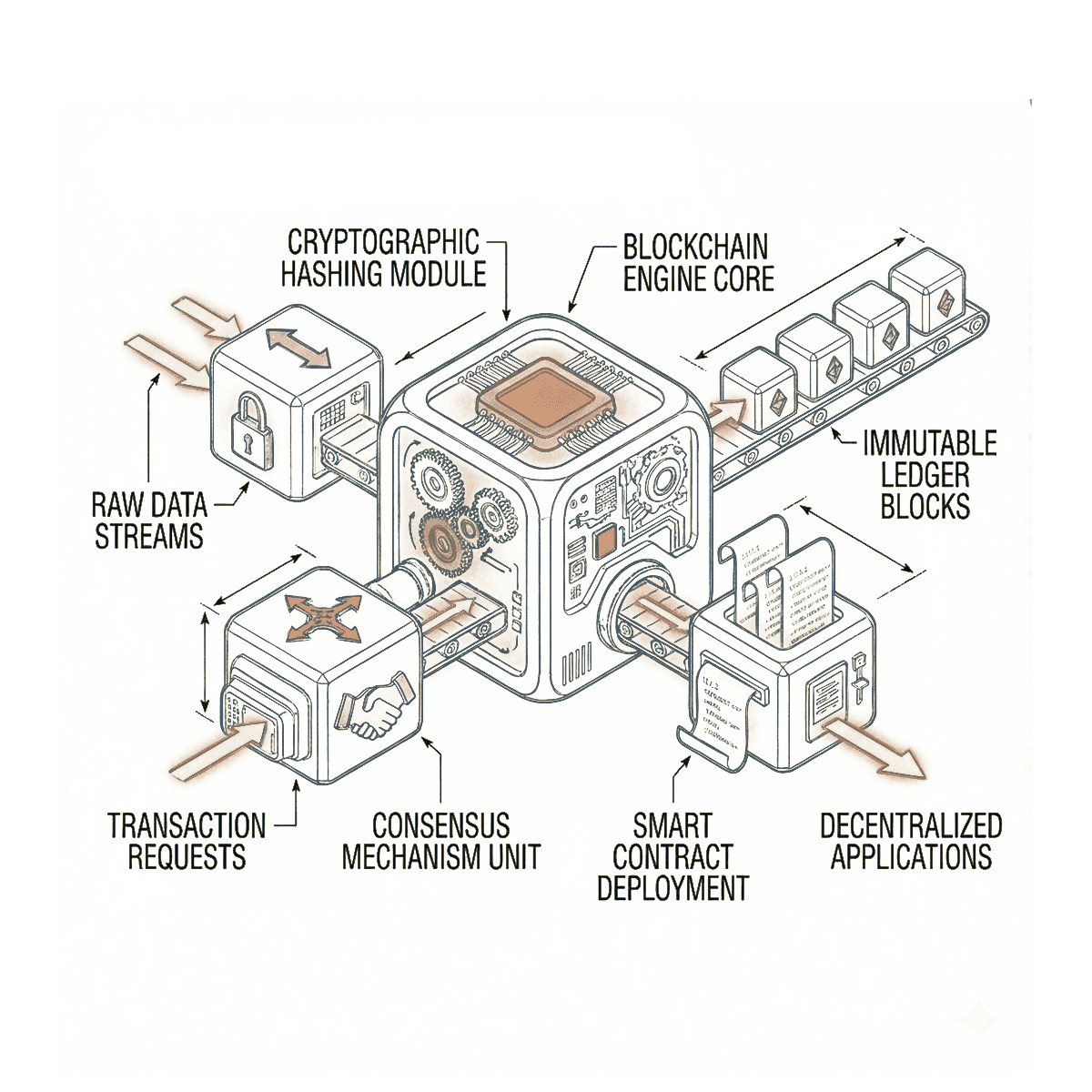
Blockchain engineering is building the actual blockchain systems, protocols, and infrastructure that everything else runs on. It's designing consensus mechanisms, optimizing node performance, implementing cryptographic primitives, building layer-2 scaling solutions, creating cross-chain bridges. It's the difference between building houses and designing the power grid that makes modern houses possible.
The confusion is understandable. Both involve blockchain technology. Both require technical expertise. But the depth, breadth, and nature of work are fundamentally different. Let's break down what blockchain engineering actually entails, how it differs from Web3 development, and why understanding this distinction matters if you're building serious blockchain infrastructure.
What Web3 Development Actually Is
Web3 development is application-layer work. You're building user-facing products that interact with existing blockchain infrastructure. Think of it as frontend and backend development, but for decentralized applications instead of traditional web apps.
Typical Web3 Developer Skillset:
Smart contract development in Solidity, Vyper, or similar high-level languages
Frontend frameworks (React, Vue, Angular) for dApp interfaces
Web3.js or Ethers.js for blockchain interaction
Wallet integration (MetaMask, WalletConnect, Coinbase Wallet)
IPFS for decentralized storage
Subgraph development for indexing blockchain data
Understanding of token standards (ERC-20, ERC-721, ERC-1155)
Web3 developers are building on top of blockchain infrastructure. They're creating DeFi protocols, NFT marketplaces, DAOs, games, social platforms—all the applications users actually interact with. This work is critical and requires genuine skill, but it's fundamentally about using existing blockchain primitives to create new products.
When a Web3 developer deploys a smart contract to Ethereum, they're not thinking about how Ethereum reaches consensus, how the EVM executes bytecode, or how nodes sync state. They're working at a higher abstraction layer, much like web developers don't need to understand TCP/IP internals to build websites.
What Blockchain Engineering Actually Is
Blockchain engineering is infrastructure-layer work. You're building the protocols, systems, and tools that Web3 developers use. It's systems programming, distributed systems design, cryptography implementation, and performance optimization at massive scale.
Typical Blockchain Engineer Skillset:
Systems programming languages (Rust, C++, Go) for performance-critical code
Deep understanding of distributed systems theory and practice
Cryptographic primitives and their implementations
Consensus algorithm design and optimization
Peer-to-peer networking protocols
Database design for blockchain state management
Virtual machine design and execution optimization
Security at the protocol level
Blockchain engineers work on problems like: How do we achieve Byzantine fault tolerance in a network with thousands of malicious actors? How do we reduce block propagation time from 13 seconds to 400 milliseconds? How do we implement zero-knowledge proofs efficiently enough for practical use? How do we create a bridge between two blockchains without trusted intermediaries?
When Base58 (base58.io) builds custom blockchain solutions for enterprises, they're doing blockchain engineering—not just deploying smart contracts, but architecting entire blockchain systems tailored to specific business requirements. That means making fundamental decisions about consensus, security models, data structures, and network topology.
The Technical Depth Difference
Let's get concrete about the technical differences with an example: building a token bridge between two blockchains.
Web3 Developer Approach: Use an existing bridge protocol like Wormhole or LayerZero. Write smart contracts on both chains that lock/unlock tokens. Create a frontend where users can initiate transfers. Integrate with wallets. Deploy and monitor. Total complexity: moderate. You're composing existing pieces into a working product.
Blockchain Engineer Approach: Design a novel bridge architecture. Implement cryptographic verification of cross-chain state. Build a relay network with economic incentives for honest operation. Optimize for minimal latency and maximum security. Implement fraud proofs for challenge periods. Handle edge cases like chain reorganizations. Total complexity: extreme. You're building new infrastructure from first principles.
Both approaches create a working bridge, but the engineering depth is vastly different. One uses building blocks, the other creates building blocks.
Consensus Mechanisms: The Heart of Blockchain Engineering
If there's one thing that separates blockchain engineers from Web3 developers, it's deep understanding of consensus mechanisms. Web3 developers know "Ethereum uses Proof of Stake" as a fact. Blockchain engineers understand why, how it works, what tradeoffs it makes, and how to implement alternatives.
What Blockchain Engineers Know About Consensus:
Proof of Work: Not just "miners solve puzzles"—understanding difficulty adjustment algorithms, selfish mining attacks, the relationship between hashrate and security, why Bitcoin chose 10-minute blocks, how mining pools work, the economics of ASIC resistance.
Proof of Stake: The complexities of validator selection, slashing conditions, the "nothing at stake" problem and how to solve it, finality gadgets like Casper FFG, liquid staking derivatives and their systemic risks.
Byzantine Fault Tolerance: PBFT, Tendermint, HotStuff—understanding the theoretical foundations, the n/3 bound on Byzantine nodes, how to achieve finality, the latency-throughput tradeoffs.
Novel Mechanisms: Avalanche consensus, Proof of History, DAG-based consensus, hybrid approaches—knowing when each makes sense and how to implement them safely.
When an enterprise needs a private blockchain with specific performance characteristics, Base58's blockchain engineers don't just pick Ethereum and call it done. They evaluate consensus requirements, choose or design appropriate mechanisms, and implement them correctly. That requires expertise Web3 development simply doesn't cover.
Performance Optimization at the Protocol Level
Web3 developers optimize gas usage in smart contracts. Blockchain engineers optimize the blockchain itself.
Blockchain Engineering Performance Work:
State Management: How do you structure blockchain state to enable efficient reads and writes? How do you prune historical data without breaking verifiability? What database backends work best for different access patterns?
Transaction Processing: Parallel execution of non-conflicting transactions. State access optimization. Signature verification batching. Mempool management strategies.
Network Layer: Block propagation optimization. Transaction gossiping protocols. Peer discovery and connection management. DDoS resistance.
Execution Environment: Virtual machine optimization. JIT compilation. Precompiled contracts for common operations. Gas metering efficiency.
When Solana claims 65,000 TPS, that's blockchain engineering—fundamental architectural decisions about parallel execution, state access, and consensus that enable that throughput. When Ethereum struggled with network congestion, the solution wasn't better dApps, it was protocol-level scaling through rollups and sharding—blockchain engineering problems.
Cryptography: From Using Libraries to Building Them
Web3 developers use cryptographic libraries. Blockchain engineers understand the mathematics, implement the algorithms, and worry about things like timing attacks, constant-time operations, and proper randomness.
Cryptography in Blockchain Engineering:
Signature Schemes: Not just calling a library function, but understanding elliptic curve mathematics, choosing appropriate curves (secp256k1 vs ed25519), implementing batch verification, dealing with signature malleability.
Zero-Knowledge Proofs: SNARKs, STARKs, Bulletproofs—understanding the mathematical foundations, implementing proving systems, optimizing proof generation and verification, choosing the right system for specific use cases.
Cryptographic Accumulators: Merkle trees, Verkle trees, polynomial commitments—understanding the tradeoffs in proof size, update costs, and verification time.
Threshold Cryptography: Multi-party computation, distributed key generation, threshold signatures for validator sets—enabling decentralization at the cryptographic level.
When zkSync or StarkNet build zero-knowledge rollups, they're doing serious cryptographic engineering—not just integrating libraries, but implementing cutting-edge cryptographic systems that make the entire architecture possible.
Security: Different Threat Models, Different Approaches
Both Web3 developers and blockchain engineers care about security, but they face different threats and use different tools.
Web3 Security Focus:
Smart contract vulnerabilities (reentrancy, integer overflow, access control)
Frontend security (preventing wallet draining attacks)
Oracle manipulation
Flash loan attacks
Governance attacks
Blockchain Engineering Security Focus:
Protocol-level attacks (51% attacks, long-range attacks, eclipse attacks)
Consensus vulnerabilities (nothing at stake, selfish mining)
P2P network attacks (eclipse attacks, transaction censorship)
Cryptographic implementation flaws (timing attacks, nonce reuse)
VM security (preventing consensus failures from code execution)
When the DAO was hacked, that was a smart contract vulnerability—Web3 security. When Bitcoin faced the inflation bug that could have created unlimited coins, that was a protocol vulnerability—blockchain engineering security. The stakes, complexity, and required expertise are different.
Tooling and Infrastructure
Web3 developers use tools. Blockchain engineers build tools.
Tools Web3 Developers Use:
Hardhat, Truffle, Foundry for smart contract development
Alchemy, Infura for RPC endpoints
The Graph for indexing
OpenZeppelin for audited contract libraries
Tenderly for debugging
Tools Blockchain Engineers Build:
Block explorers that parse and display chain state
Node implementations in different languages
Custom RPC endpoints optimized for specific use cases
Indexing infrastructure for chain data
Development frameworks for the entire ecosystem
When you use Etherscan, you're using a tool built by blockchain engineers who understand how to parse block data, reconstruct contract interactions, and present chain state in human-readable form. When you spin up a Geth node, you're using software built by blockchain engineers who implemented the Ethereum protocol in Go.
When You Need Blockchain Engineering vs Web3 Development
The distinction matters because hiring the wrong expertise wastes time and money.
You Need Web3 Development When:
Building a DeFi protocol on existing chains
Creating an NFT marketplace
Developing a DAO governance system
Building consumer-facing blockchain applications
Integrating blockchain into existing products
You Need Blockchain Engineering When:
Building a custom blockchain for specific business requirements
Creating layer-2 scaling solutions
Developing cross-chain infrastructure
Optimizing existing blockchain performance
Implementing novel consensus mechanisms
Building blockchain analytics and monitoring systems
Most blockchain projects need Web3 development. You're building on Ethereum, Solana, or Polygon, and you need people who can write smart contracts and build user interfaces. That's the right approach for most use cases.
But some projects need deeper infrastructure work. Enterprise blockchains with specific compliance requirements. High-performance chains for gaming. Privacy-focused chains for sensitive data. Cross-chain infrastructure. These require blockchain engineering.
Base58 maintains teams with both skillsets because different problems require different solutions. Sometimes clients need a sophisticated dApp built on existing infrastructure. Sometimes they need custom blockchain systems designed from the ground up. Understanding which is which saves months of development time and hundreds of thousands of dollars.
The Learning Path Difference
Becoming competent in each field requires different learning paths.
Web3 Developer Path:
Learn JavaScript and modern frontend frameworks
Study smart contract development (Solidity/Vyper)
Understand blockchain basics and how Web3 libraries work
Build projects: token contracts, NFTs, simple DeFi protocols
Learn about oracles, indexing, wallet integration
Study common vulnerabilities and security best practices
Timeline: 6-12 months for competency with web development background.
Blockchain Engineer Path:
Master systems programming (Rust/C++/Go)
Deep dive into distributed systems theory
Study cryptography—not just using it, but understanding it
Learn about consensus algorithms, Byzantine fault tolerance
Read blockchain protocol specifications and implementations
Contribute to blockchain core development
Study blockchain performance optimization
Understand economic security models
Timeline: 2-3+ years for competency even with strong systems programming background.
The depth difference is real. Web3 development is accessible—you can start building useful applications relatively quickly. Blockchain engineering requires years of specialized study because you're working at a level where mistakes can compromise entire networks.
The Compensation Difference
The market reflects the skillset rarity.
Competent Web3 developers earn $100k-200k depending on experience and location. There are thousands of them. The skillset, while valuable, is teachable at bootcamp scale.
Senior blockchain engineers earn $200k-500k+ because there are maybe a few thousand globally who can actually do this work. The skillset requires years of specialized experience that can't be taught quickly.
When Base58 hires blockchain engineers, they're looking for people who've contributed to blockchain core protocols, who understand consensus at a deep level, who can read and write systems code, who grasp the cryptographic foundations. These people are rare, expensive, and worth every dollar when you need actual infrastructure work done.
Where the Lines Blur
In practice, the distinction isn't always clean. The best Web3 developers understand protocol-level concepts even if they don't implement them. The best blockchain engineers can write smart contracts when needed.
Senior people in the space often have both skillsets. They might have started as Web3 developers, gotten curious about lower-level problems, and spent years learning blockchain engineering. Or they came from systems programming, learned about blockchain, and picked up Web3 development as needed.
Companies building serious blockchain infrastructure—like Base58—need both. They need blockchain engineers to design and implement the core systems. They need Web3 developers to build applications on top of that infrastructure. They need people who understand the entire stack and can bridge the gaps.
Why the Terminology Matters
Calling everything "blockchain development" obscures important distinctions. It's like calling both electricians and electrical engineers "people who work with electricity." Technically true, but misleading.
When companies hire "blockchain developers," they often don't know whether they need Web3 development or blockchain engineering. They end up hiring Web3 developers for infrastructure problems or blockchain engineers for application work. Both scenarios waste expertise and money.
When you talk to Base58 about a blockchain project, they start by understanding what you actually need. Application on existing infrastructure? That's Web3 development. Custom blockchain system? That's blockchain engineering. Multi-chain infrastructure connecting different protocols? That's both—and they'll assemble the right team.
The Future Is Specialized
As blockchain technology matures, the distinction between Web3 development and blockchain engineering will become more pronounced, not less.
Web3 development will increasingly resemble traditional web development—higher-level abstractions, better tooling, more developers. It'll become easier to build blockchain applications without deep protocol knowledge.
Blockchain engineering will become even more specialized—more complex protocols, more sophisticated cryptography, more demanding performance requirements. The infrastructure layer will require even deeper expertise as the technology advances.
Both are necessary. Both are valuable. But they're different fields with different requirements, different learning paths, and different career trajectories. Understanding the distinction helps you hire right, build right, and understand what's actually involved in blockchain technology.
Conclusion
The difference between Web3 development and blockchain engineering isn't about prestige or superiority—it's about specialization. Web3 developers build the applications users interact with. Blockchain engineers build the infrastructure those applications run on. Both are essential, both require skill, and both solve important problems. But when you're making hiring decisions, planning a blockchain project, or evaluating technical proposals, understanding this distinction is critical. You wouldn't hire a web developer to design your database architecture. You shouldn't hire a Web3 developer to build your blockchain infrastructure. Base58 (base58.io) maintain expertise across both domains because real-world blockchain projects often need both. They can architect custom blockchain systems when infrastructure work is necessary, and they can build sophisticated applications on existing chains when that's the right approach. They understand the technical distinctions, the cost implications, and the capabilities of each.

Leo Park
Blockchain Expert