What Makes a Blockchain System Production-Ready?
DAte
Category
All
Reading Time
10 Min
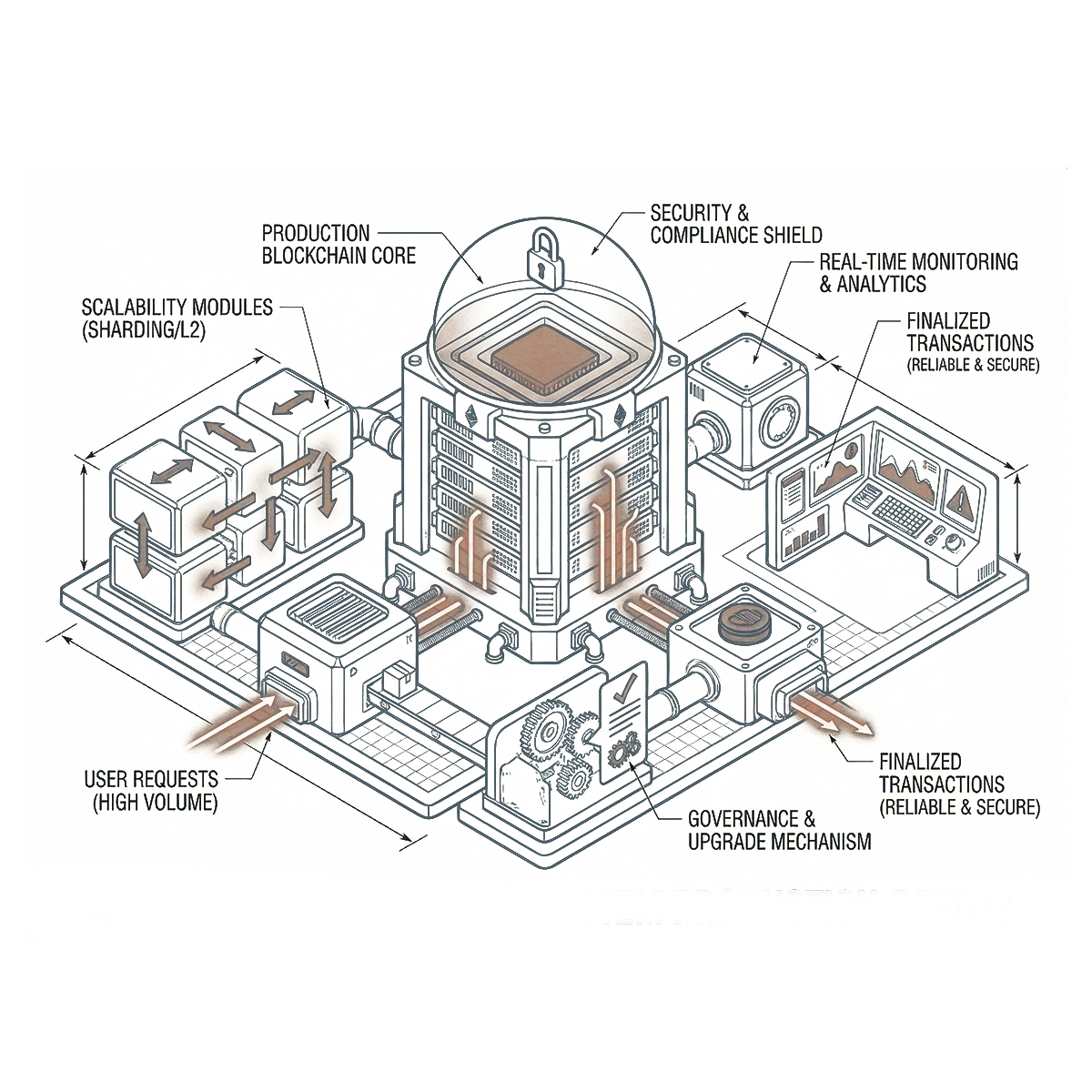
Here's a dirty secret about blockchain: most blockchain projects never make it to production. Not because the technology doesn't work—it does. Not because the use case is flawed—often it's sound. They fail because building a demo that impresses investors is fundamentally different from building a system that can run 24/7, handle thousands of users, survive attacks, comply with regulations, and not lose anyone's money.
I've seen countless "blockchain solutions" that work beautifully in controlled environments and catastrophically in the real world. A smart contract that costs $50 in gas fees per transaction. A "decentralized" system that goes offline when one server reboots. A token platform that gets drained by a white-hat hacker in the first week. A compliance nightmare that regulators shut down before it processes its hundredth transaction.
Production-ready blockchain isn't about fancy consensus algorithms or cutting-edge cryptography. It's about unglamorous, critical infrastructure work: security audits, monitoring systems, disaster recovery, regulatory compliance, user experience that doesn't require a PhD to navigate. Let's talk about what actually matters when you're putting real value on a blockchain system.
Security: Because "Oops" Isn't an Option
In traditional software, bugs are annoying. In blockchain, bugs are existential. Once you deploy a smart contract, it's immutable. If there's a vulnerability, you can't patch it. If someone drains funds, you can't reverse transactions. The code is law, and bad code is bad law.
The stakes get real when you consider that blockchain systems are public, adversarial environments. Your code isn't running on a protected server behind firewalls—it's exposed to the entire internet, with built-in financial incentives for anyone who can exploit it. Every vulnerability is worth real money to attackers.
Production-ready blockchain security means multiple layers:
Code Audits by Multiple Firms: One audit isn't enough. You need at least two independent security firms reviewing your smart contracts. Different auditors catch different issues. Budget $50,000-$200,000 for proper audits depending on complexity. Sounds expensive? A single exploit costs infinitely more.
Formal Verification: Mathematical proofs that your code does what you claim. It's slow, expensive, and doesn't catch everything—but for critical functions like fund transfers, it's non-negotiable. If you're handling significant value, formal verification separates professionals from amateurs.
Bug Bounty Programs: Pay white-hat hackers to find vulnerabilities before black-hats do. Offering $100,000 for a critical bug is cheaper than losing $10 million to an exploit. The best security teams actively invite scrutiny.
Multi-Signature Controls: No single person should have unilateral control over production systems. Critical operations require multiple parties to sign off. This slows things down—that's the point. Speed kills in security.
Time Locks and Emergency Pauses: Build in circuit breakers. If something goes wrong, you need ways to pause operations, even if you can't change the underlying code. These mechanisms are your insurance policy.
Companies like Base58 (base58.io) build security into every layer of their blockchain implementations. They've seen what goes wrong when security is an afterthought, and they architect systems assuming attackers are already probing for weaknesses—because they are.
Scalability: When Success Becomes a Problem
Your prototype works perfectly with 10 test users. What happens when 10,000 real users show up?
Blockchain scalability is brutally unforgiving. Unlike traditional systems where you can throw more servers at the problem, blockchain throughput is constrained by fundamental design choices made at the protocol level. You can't just "scale up" a blockchain the way you scale a web app.
Production systems need to handle:
Transaction Volume: Can your system process enough transactions per second for your use case? Ethereum mainnet does about 15-30 TPS. That's fine for some applications, catastrophic for others. If you're building a high-frequency trading platform, you need layer-2 solutions or alternative blockchains entirely.
Gas Fee Management: On public blockchains, transaction costs vary wildly. Your system needs to work when gas prices spike 10x during network congestion. That means either absorbing costs, batching transactions, or moving to more cost-effective chains. Users won't pay $100 to claim a $50 reward.
State Growth: Blockchains store data forever. Every transaction, every state change adds to the chain. Your "simple" NFT marketplace might generate gigabytes of data monthly. Someone has to store and serve that data. Production systems need strategies for data availability and archiving.
Load Balancing: Even if the blockchain scales, do your RPC endpoints? Can your infrastructure handle traffic spikes? What happens when a popular mint crashes your frontend while the blockchain hums along fine?
Real-world scalability means stress testing with realistic loads, building infrastructure that can handle 10x your expected peak traffic, and having fallback strategies when primary systems get overwhelmed. Base58 designs blockchain systems with scalability baked in from day one—because retrofitting scalability after launch is painful and expensive.
Monitoring and Observability: You Can't Fix What You Can't See
Traditional systems have decades of mature monitoring tools. Blockchain systems? Not so much. You're operating in a new environment with unique failure modes, and standard tools don't cut it.
Production blockchain systems need:
Transaction Monitoring: Real-time tracking of all transactions. Which ones succeeded? Which failed and why? Are gas prices optimal? Are transactions stuck in the mempool? You need visibility into the entire transaction lifecycle.
Smart Contract Events: Properly emitted events are your window into contract execution. Production contracts should log everything important, and you should have systems aggregating and analyzing those logs.
Wallet and Account Monitoring: Track balances, detect unusual activity, flag suspicious patterns. If a treasury wallet suddenly drains, you want to know immediately—not when users start complaining.
System Health Metrics: Node uptime, API response times, database performance, error rates. Just because the blockchain is decentralized doesn't mean your infrastructure is. Your APIs, frontends, and backend services all need monitoring.
Alerting That Works: PagerDuty integration, SMS alerts, automated escalation. When something breaks at 3 AM, someone needs to know and someone needs to fix it. Production systems don't keep business hours.
Good monitoring isn't about collecting data—it's about actionable insights. Base58 implements comprehensive monitoring stacks for their blockchain deployments because in production, the difference between detecting an issue in 5 minutes versus 5 hours can mean the difference between a minor incident and a catastrophe.
Compliance and Legal Framework: Because Laws Still Apply
Here's what blockchain evangelists often forget: deploying on a "censorship-resistant" blockchain doesn't exempt you from laws. If you're handling user funds, personal data, or regulated assets, you still need compliance infrastructure.
Production-ready blockchain systems address:
KYC/AML Requirements: For financial applications, you need Know Your Customer and Anti-Money Laundering processes. That means identity verification, transaction monitoring for suspicious activity, reporting obligations. The blockchain might be permissionless, but your access layer probably can't be.
Data Privacy: GDPR, CCPA, and similar regulations create interesting challenges for immutable blockchains. How do you delete user data when it's on-chain forever? Production systems need strategies—typically keeping personal data off-chain with only hashes on-chain.
Securities Regulations: Tokenizing assets? You're probably creating securities, which means SEC registration, investor accreditation checks, and compliance reporting. The token might be on blockchain, but the legal framework is very much off-chain.
Tax Reporting: Users and regulators need transaction records for tax purposes. Production systems provide export capabilities, transaction histories, and documentation that satisfies tax authorities.
Terms of Service and Legal Recourse: Smart contracts might be "trustless," but users still need legal agreements defining what happens when things go wrong. What's the dispute resolution process? What jurisdiction applies? These questions need answers before launch.
Professional blockchain firms like Base58 work with legal experts to ensure their implementations meet regulatory requirements. The technology might be cutting-edge, but compliance is table stakes for production deployment.
User Experience: Because Users Don't Care About Your Blockchain
Here's an uncomfortable truth: your users don't care that you're using blockchain. They care whether your product works, whether it's easy to use, and whether it solves their problem. Forcing them to understand gas fees, transaction confirmations, and wallet management is asking them to care about your implementation details.
Production-ready UX means:
Abstracting Blockchain Complexity: Users shouldn't need to know what a blockchain is to use your product. Gas fees? Handle them in the background. Wallet setup? Use social recovery or custodial solutions for mainstream users. Transaction confirmations? Show status updates in plain English.
Error Handling That Makes Sense: "Transaction reverted" isn't helpful. "Payment failed because your wallet doesn't have enough ETH for gas fees" is. Production systems translate blockchain errors into messages humans understand.
Performance That Feels Instant: Blockchain transactions take time—seconds to minutes depending on the chain. But users expect instant feedback. Production UX uses optimistic updates, loading states, and progress indicators to make async operations feel responsive.
Graceful Degradation: What happens when the RPC endpoint is slow? When the wallet connection drops? When gas prices spike beyond what users will pay? Production systems handle these failures gracefully instead of leaving users staring at loading spinners.
Mobile-First Design: Most users access applications on phones. Your blockchain system needs to work perfectly on mobile, with wallet connections that don't break, interfaces that fit small screens, and performance that works on variable network conditions.
Base58 prioritizes user experience in their blockchain implementations because technology that users hate doesn't get adopted, no matter how technically sophisticated it is.
Infrastructure Redundancy: Single Points of Failure Are Unacceptable
Decentralized blockchain, centralized infrastructure—that's the reality of most blockchain applications. The blockchain itself might be distributed, but your RPC nodes, APIs, databases, and frontends probably aren't. Production systems eliminate single points of failure.
Multiple RPC Providers: Don't rely on a single Infura or Alchemy endpoint. Use multiple providers with automatic failover. When one goes down (and they do), your system should seamlessly switch to backups.
Geographic Distribution: Host infrastructure across multiple regions and providers. AWS us-east-1 goes down regularly. If that takes your entire blockchain application offline, you're not production-ready.
Database Replication: Any off-chain data—user profiles, cached blockchain state, analytics—needs redundancy. Primary database fails? Failover to replicas should be automatic and transparent.
CDN and Edge Caching: Static assets, frontend code, frequently accessed data—all should be distributed globally via CDN. Users in Asia shouldn't have to wait for responses from US servers.
Disaster Recovery Plans: Document and test your recovery procedures. If everything burns down, how quickly can you restore service? What's your RTO (Recovery Time Objective) and RPO (Recovery Point Objective)? Have you actually tested your backups?
Production infrastructure costs more than development infrastructure. That's not waste—that's insurance.
Testing Beyond "It Works"
Testing blockchain systems requires different approaches than traditional software:
Mainnet Forks for Testing: Test against actual mainnet state. Testnet conditions don't reflect production reality—different gas prices, different contract interactions, different edge cases.
Stress Testing: Load test everything. What happens when 1000 users mint simultaneously? When gas prices spike during your critical operation? When the blockchain is congested?
Adversarial Testing: Hire people to actively try breaking your system. Pen tests, security audits, bug bounties—production systems are battle-tested before launch.
Integration Testing: Blockchain doesn't exist in isolation. How does it integrate with your payment processors, your databases, your user authentication? Test the complete system, not just the smart contracts.
Upgrade and Migration Testing: Smart contracts might be immutable, but systems evolve. How do you migrate users to new versions? How do you handle data migration? Test these processes before you need them in production.
Base58's development process includes extensive testing at every stage because in blockchain, you typically don't get do-overs. Launch with bugs and you're either stuck with them or going through expensive redeployment and migration processes.
Documentation and Runbooks: When Things Go Wrong at 3 AM
Production systems need documentation that actually helps:
Architecture Documentation: How does the system work? What are the critical components? Where can failures occur? New team members and incident responders need this context.
Operational Runbooks: Step-by-step procedures for common operations and incident response. How do you pause the system? How do you upgrade contracts? What's the process for investigating suspicious transactions?
API Documentation: Clear, comprehensive, up-to-date API docs for anyone integrating with your system. Include code examples, error handling, rate limits.
User Documentation: Help articles, FAQs, troubleshooting guides. Your support team needs resources to help users without escalating everything to engineering.
Post-Mortem Reports: When things break (and they will), document what happened, why it happened, and how you're preventing it from happening again. Public post-mortems build trust.
Documentation isn't glamorous, but it's the difference between resolving incidents in 15 minutes versus 3 hours.
The Production Checklist
Before you call a blockchain system production-ready, you should be able to confidently answer "yes" to these questions:
Has the code been audited by at least two independent security firms?
Have you stress tested with 10x expected load?
Do you have 24/7 monitoring with automatic alerts?
Is your infrastructure redundant across multiple providers and regions?
Can you handle regulatory compliance requirements for your jurisdiction?
Does the UX work for non-technical users?
Have you documented emergency procedures and incident response?
Do you have a disaster recovery plan that you've actually tested?
Can the system handle blockchain congestion and gas price spikes?
Have you set up proper access controls and multi-sig requirements?
If any answer is "no" or "mostly," you're not ready for production.
Why Experience Matters
Building production blockchain systems isn't just about technical skills—it's about pattern recognition from seeing what goes wrong. It's knowing that the edge case you're thinking of dismissing will absolutely bite you in production. It's understanding the difference between "secure enough for a demo" and "secure enough to sleep at night."
Companies like Base58 (base58.io) have built and deployed dozens of production blockchain systems. They've seen the failures, learned from the incidents, and built processes to prevent repeat mistakes. They know which corners can't be cut and which optimizations actually matter.
When you're deploying a blockchain system that will handle real value, real users, and real liability, experience isn't just valuable—it's essential. The difference between a team that's done this before and one figuring it out as they go can be millions of dollars and company reputation.
The Reality of Production Blockchain
Production-ready blockchain is expensive, time-consuming, and far less glamorous than whiteboards full of architecture diagrams. It's months of security audits, testing, compliance work, and infrastructure setup. It's building monitoring dashboards, writing documentation, and creating operational procedures.
But it's also the only way to actually deploy blockchain technology that works reliably, secures user funds, complies with regulations, and delivers on the promise of this technology. Everything else is just expensive demos.
The blockchain revolution everyone talks about? It's not happening in proof-of-concept prototypes. It's happening in production systems that work day after day, handling real transactions, solving real problems, delivering real value. Systems that are boring, reliable, and secure.
That's what production-ready means. And that's what separates actual blockchain innovation from vaporware.
Conclusion
The gap between a blockchain prototype and a production system is vast—and most projects never bridge it. Not because the technology is immature, but because production deployment requires unglamorous, meticulous work that doesn't generate headlines or impress investors. The gap between a blockchain prototype and a production system is vast—and most projects never bridge it. Not because the technology is immature, but because production deployment requires unglamorous, meticulous work that doesn't generate headlines or impress investors.

Leo Park
Blockchain Expert